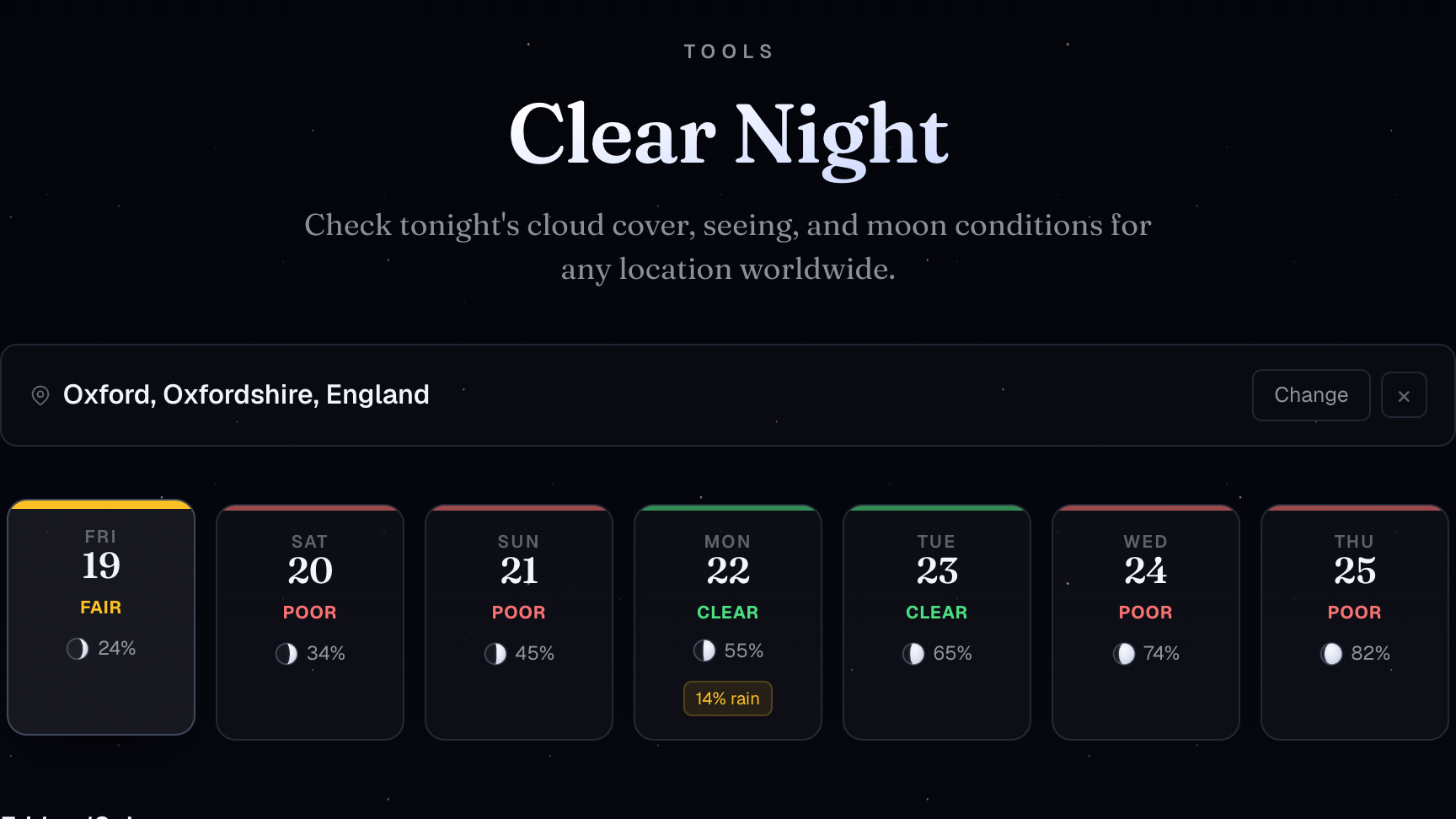
Finding a clear night for astrophotography in the UK is part skill, part luck, and a lot of refreshing weather apps that weren't designed with narrowband imaging in mind. Standard forecasts tell you whether to bring an umbrella. They don't tell you whether 30% cloud cover is concentrated in cirrus layers that will wreck your transparency, or whether the dew point gap is narrow enough to warrant a dew heater. That gap in information is what prompted me to build something better.
So: Clear Night is live. Head over and try it now, or read on for a look at what it does.
The week ahead
Enter a location and you get a seven-night forecast laid out as a row of summary cards. Each card shows a strip of coloured dots (one per hour of the night), so you can quickly see which hours are worth imaging and which aren't. Below the dots sits the moon illumination and rain chance, with a wind flag when gusts pick up. Tap a card to open the full hourly detail below.
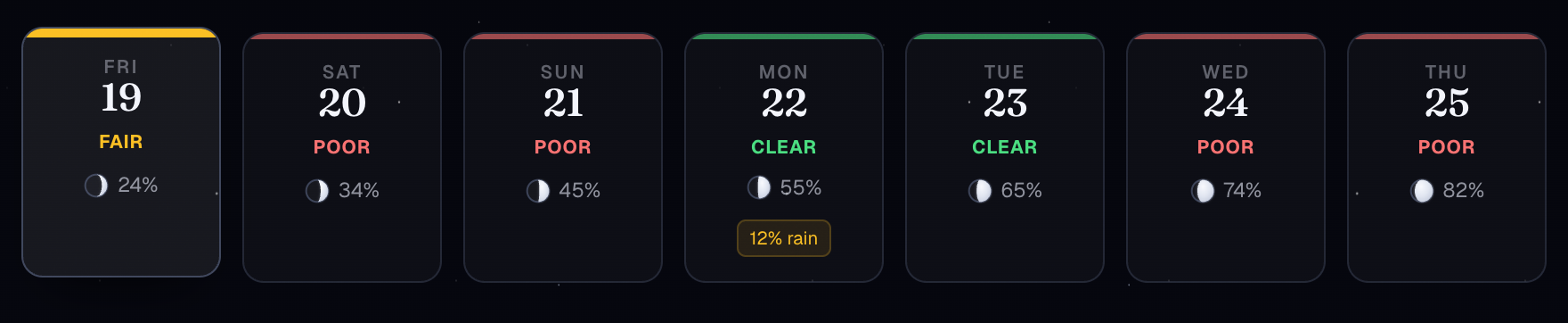
The dot colours aren't just cloud cover. Each hour is graded on everything that actually matters: total cloud, high cirrus, rain chance, wind speed and gusts, dew, and seeing and transparency from the 7Timer! atmospheric model where it has data. The worst of those sets the grade, because one bad factor ruins a session however good the rest is. High cirrus gets its own limit, as a thin veil at altitude can kill transparency even when the total cloud figure looks fine.
The grading is strict on purpose. Any real chance of rain, or strong wind or gusts at any point after sunset, rules the whole night out, because that's what damages kit. To earn Clear, at least 70% of the properly dark hours have to be Clear.
Into the detail
Clicking a night card opens the full hourly breakdown. This is where it gets useful.
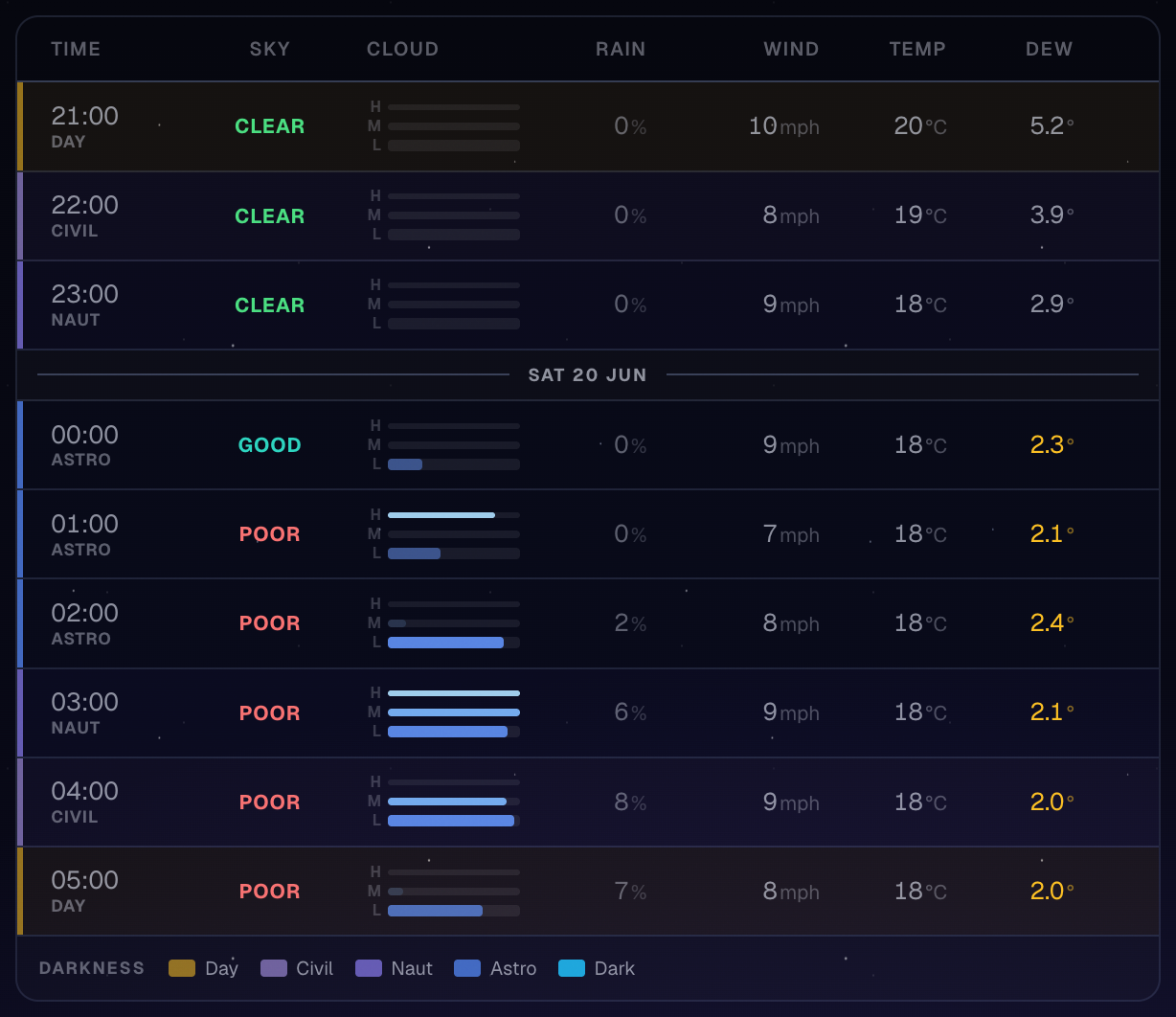
The table runs left to right from the headline to the detail: time, an hourly Sky rating, cloud, then rain, wind, temperature and dew.
- Sky: every hour gets its own Clear/Good/Fair/Poor rating, so you can see precisely which slice of the night is worth being set up for.
- Cloud split by altitude: high, mid and low layers shown as separate bars, so you can tell a thin high veil from a solid low base rolling in.
- Rain: precipitation probability, because getting caught out with the kit exposed is exactly as bad as you'd expect.
- Wind: average speed with the gusts underneath, coloured once they're strong enough to cost the hour its grade.
- Temperature and dew spread: a dew spread under 1°C is the warning sign for condensation on your optics, so it gets a colour cue while comfortable values stay quiet.
Colour is kept deliberately sparse. The Sky column carries the headline and the number columns only light up when something needs attention, so the table doesn't end up covered in colour. Each row is shaded from dusk through to full astronomical darkness, so you can see when proper imaging time begins.
Seeing and transparency
For the next few nights (7Timer! forecasts about three days ahead), the sidebar shows seeing and transparency on an 8-point quality scale. Both are shown as simple dot gauges. Seeing is the steadiness of the atmosphere (which limits resolution on planets and tight double stars), while transparency is the clarity from aerosols and dust (which affects how faint you can go in broadband).
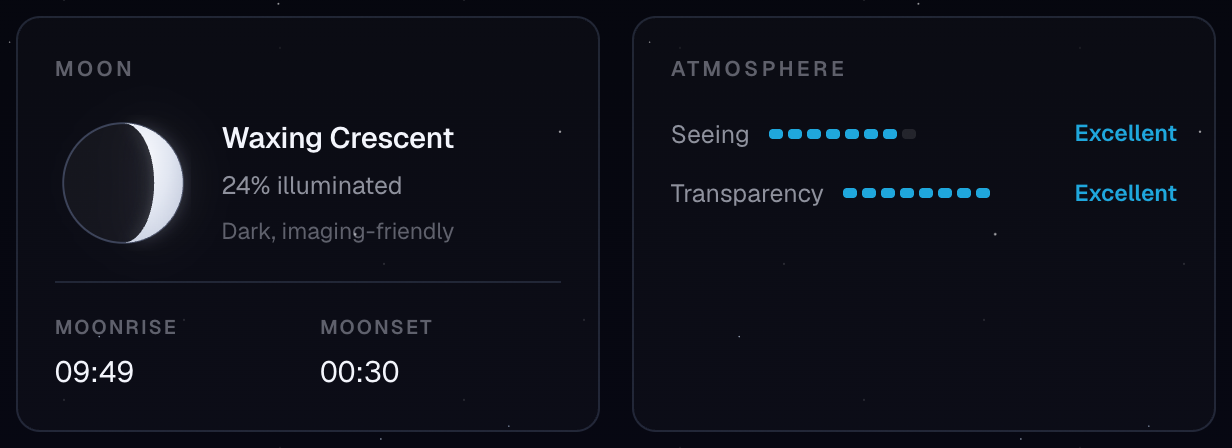
The moon panel sits alongside it. The phase is drawn as a lit disc, with the illumination percentage, rise and set times, and a one-line note on what it means for imaging: a dark crescent is friendly, a bright gibbous washes out the faint stuff. That's enough to plan around the moon without reaching for another app.
How to use it
- Open the app
- Type your town or UK postcode, or tap "Use my location" to let the browser do it
- The tool remembers your location for next time
It works worldwide. The weather forecast itself (cloud, wind, temperature, rain) comes from Open-Meteo and runs a week ahead, while seeing and transparency from 7Timer! only reach about three days out.
I hope it proves useful. As I start relying on it for my own sessions I'll no doubt tweak the grading thresholds, add the odd bit of detail, and generally refine it over time. But the core of it is there and working, so give it a go on your next clear night.
Clear skies!