
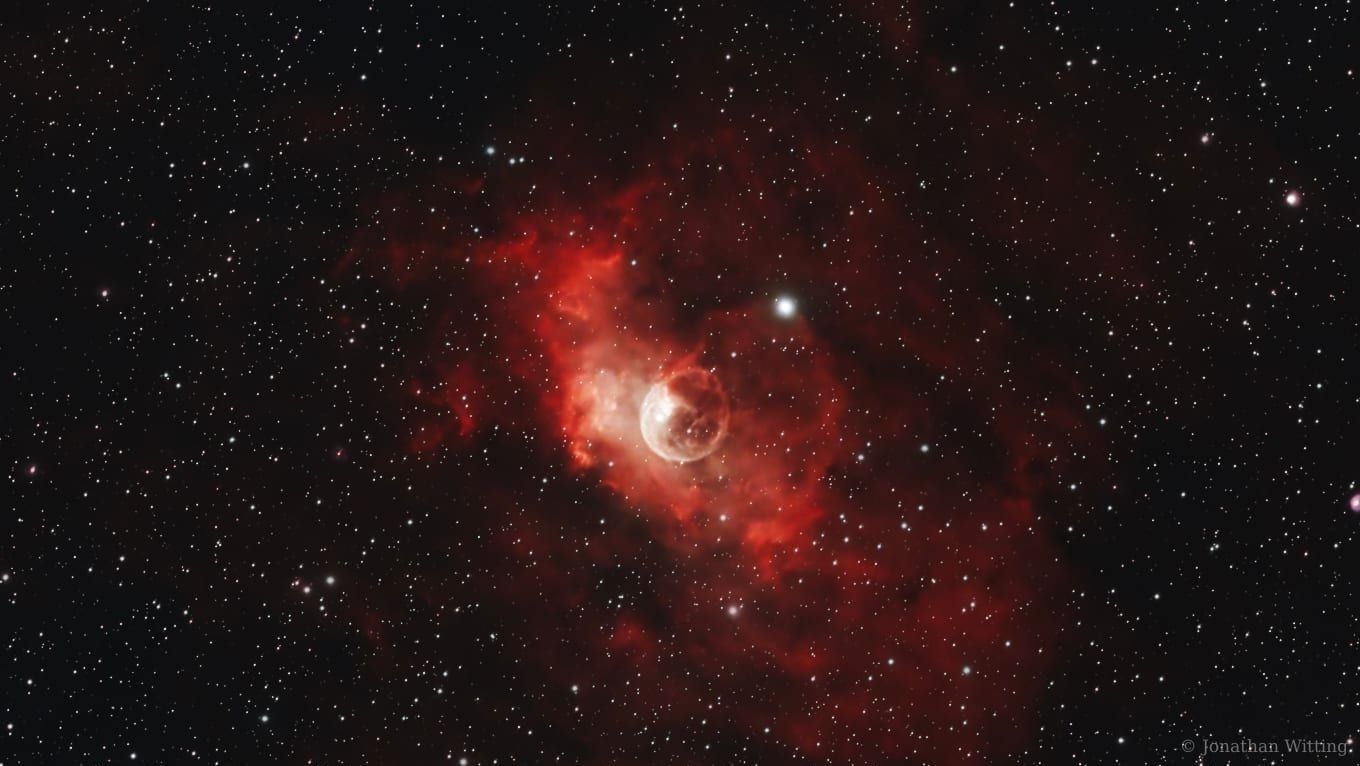
The Bubble Nebula looks like it shouldn't be real: an almost perfect sphere of gas, seven light years across, hanging in a larger field of hydrogen nebulosity. The sculptor is the star just off-centre inside it, SAO 20575 (BD+60°2522), a star dozens of times the mass of the Sun whose stellar wind is inflating the bubble at around 100,000 kilometres per hour.
The off-centre star is the giveaway detail: the surrounding cloud is denser on one side than the other, so the bubble expands lopsidedly, and one rim glows brighter where the wind ploughs into thicker gas.
The essentials
| Designation | NGC 7635 / Caldwell 11 |
| Type | Emission nebula (wind-blown bubble) |
| Constellation | Cassiopeia |
| Distance | ≈ 7,000 to 11,000 light years |
| Apparent size | ≈ 15′ × 8′ (bubble ≈ 3′) |
| Best season (UK) | August to December |
The challenge
The bubble itself is small, about three arcminutes, a tenth of the Moon's diameter. This is the rare deep-sky nebula that rewards focal length:
- Below about 600mm it's a detail in a wider scene. Lean into that and frame it with the open cluster M52 and the Lobster Claw Nebula (Sh2-157) nearby, a gorgeous composition in its own right.
- From about 800mm upwards the bubble becomes the subject, and on a night of good seeing you'll resolve the delicate brightening along its rim.
Being circumpolar from the UK, it's available for a long season and passes very high. No altitude excuses with this one.
Capture notes
- Filters: strong in Hα with usable OIII around the bubble itself, so both HOO and full SHO palettes work well. From dark skies, RGB with an Hα blend is lovely and keeps natural star colour.
- Seeing matters: at the focal lengths this target wants, a night of steady air is worth three nights of average air. Keep your best-seeing data for the bubble.
- Guiding: long focal length means tight guiding tolerances. Sort your guiding before burning a clear night on this.
Processing notes
The bubble sits inside brighter surrounding nebulosity, so global contrast moves won't separate it. Use local contrast enhancement through a mask confined to the bubble and its rim. Deconvolution (or a sharpening pass on the linear data) earns its keep here more than on any large target, but only on well-sampled, well-guided data. On soft data it just manufactures artefacts.