
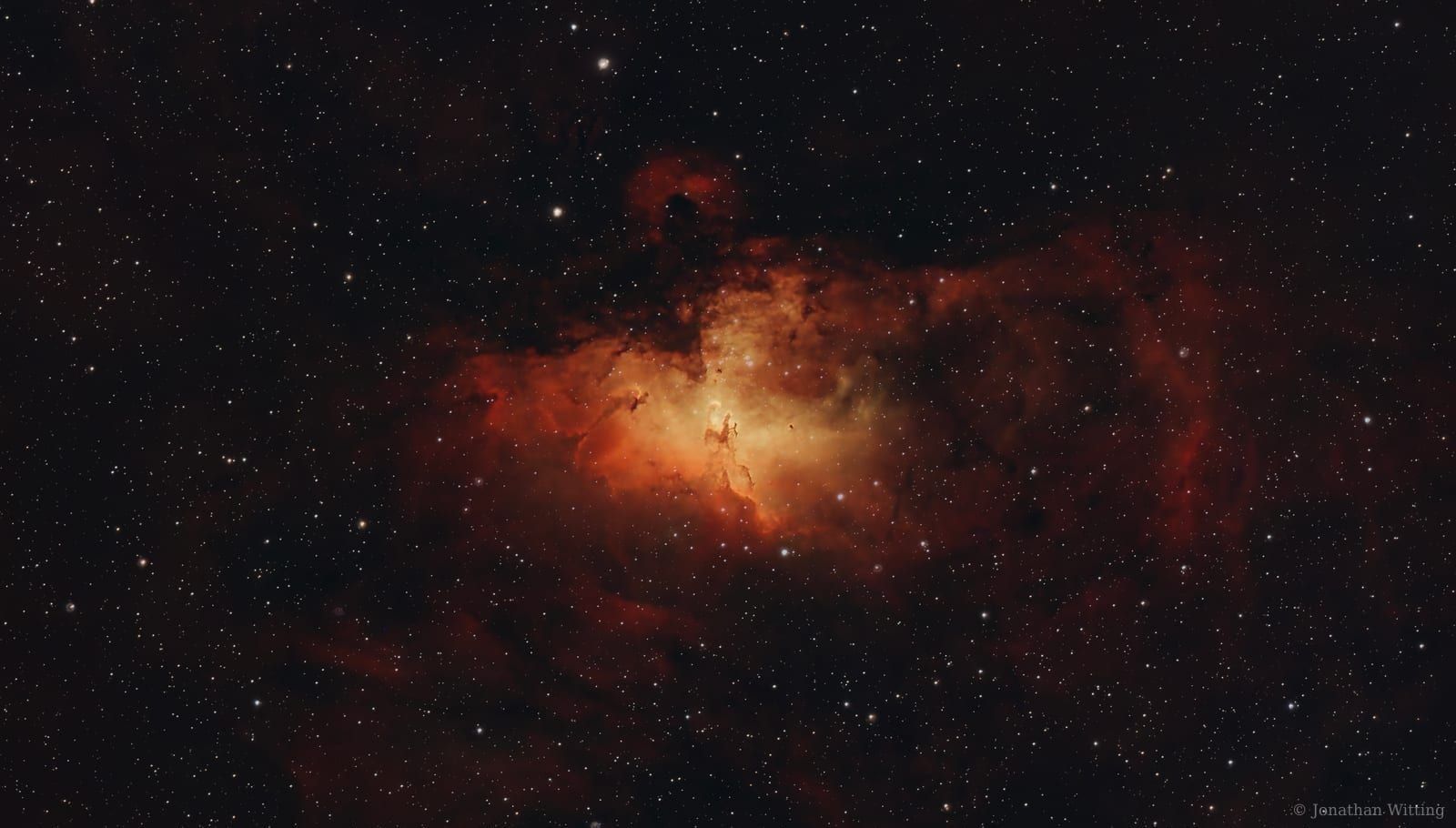
Few objects in the sky carry the cultural weight of the Eagle Nebula. The Hubble image of its central Pillars of Creation is probably the most famous astronomical photograph ever made, and those same pillars are within reach of a back garden telescope.
M16 is really two objects sharing one catalogue entry: a young open star cluster (NGC 6611, just a few million years old) and the cloud of glowing hydrogen it's embedded in. The cluster's hot young stars are simultaneously illuminating the nebula and tearing it apart. The pillars are columns of denser gas that have so far resisted the erosion, with new stars condensing inside them.
The essentials
| Designation | M16 / NGC 6611 (cluster) + IC 4703 (nebula) |
| Type | Emission nebula with open cluster |
| Constellation | Serpens (Cauda) |
| Distance | ≈ 7,000 light years |
| Apparent size | ≈ 35′ × 28′ |
| Best season (UK) | June to September |
The altitude problem
The catch for UK imagers: M16 sits at roughly minus 14 degrees declination, which means it never climbs much above 25 degrees altitude from southern England, and lower still further north. That brings two consequences:
- A short imaging window. You get perhaps three useful hours a night around the meridian. Plan multi-night integrations.
- More atmosphere to shoot through. Expect softer detail and stronger gradients than on an overhead target. Narrowband filters help enormously here, both with the low-altitude sky glow and the short summer nights that never get fully dark.
It's worth the trouble. There's a reason everyone shoots this object.
Capture notes
- Framing: at moderate focal lengths (500 to 1000mm) the whole eagle shape fills the frame nicely, with the pillars resolved at its centre. Wider fields can pair it with the Swan Nebula (M17) half a degree-hop south; the two share the frame beautifully at 250 to 350mm.
- Filters: this is a hydrogen-alpha powerhouse. Hα subs will look spectacular even from a bright suburb. Add OIII and SII and you have the classic Hubble palette (SHO) target.
- Exposure: the core is bright, so check that the pillars aren't saturating. A set of shorter subs for the core blends in well if they are.
Processing notes
The pillars live in the brightest part of the nebula, so protect them during the
stretch; a hard stretch flattens them into the background glow. Build the stretch
gently and use local contrast (LocalHistogramEqualization in PixInsight at a
couple of scales, through a mask) to make the central structures stand proud.