
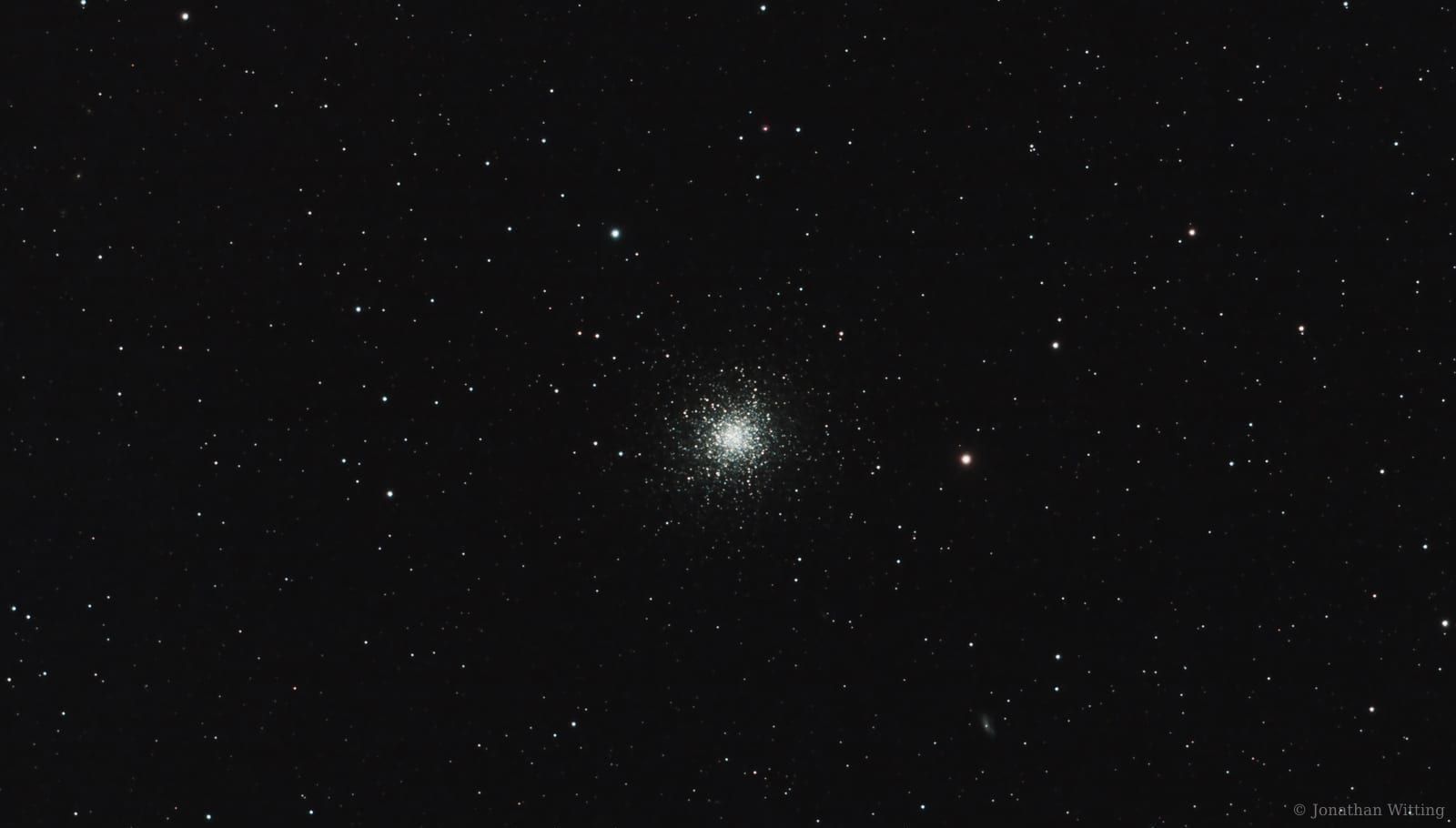
M13 is a swarm of several hundred thousand stars packed into a ball roughly 145 light years across, orbiting the Milky Way around 22,000 to 25,000 light years from us (estimates vary). These are ancient stars, most of them older than the Sun by billions of years, and they are crowded together so tightly near the core that the night sky there would blaze with thousands of brilliant points.
Edmond Halley spotted it in 1714, and from a dark site you can just about find it with the naked eye as a fuzzy "star" on the western side of the Keystone asterism. Through a telescope, or in a stacked image, it resolves into a glittering ball with chains of stars streaming away from the edges.
The essentials
| Designation | M13 / NGC 6205 |
| Type | Globular cluster |
| Constellation | Hercules |
| Distance | ≈ 22,000 to 25,000 light years |
| Apparent size | ≈ 20′ |
| Best season (UK) | April to August |
Why it's a great target
Globulars are the perfect antidote to the short nights of British summer. M13 is bright, rides high in the UK sky through spring and into summer, and doesn't demand a huge integration. It's also a pure broadband RGB object: there's no nebulosity to tease out, so narrowband filters do nothing here. A one-shot-colour camera and an hour or two of data will give you a really satisfying result.
The catch is dynamic range. The core is far brighter than the outskirts, and the usual deep-sky habit of long subs will burn it into a featureless white blob.
Capture notes
- Framing: at around 20 arcminutes, M13 sits comfortably in my 382mm field with plenty of breathing room. Look for the small edge-on galaxy NGC 6207 about half a degree away; it makes a lovely supporting detail.
- Exposures: go short. I used 199 × 30 second subs (about 1.7 hours) at unity gain, and 30 seconds proved a good balance: enough signal per sub, but the core stayed resolved into individual stars. I wrote the session up in full in Photographing M13.
- Guiding: with the whole image made of stars, trailing has nowhere to hide. Take the time to polar align and balance carefully before you start.
- Moon: broadband targets normally hate moonlight, but M13 is bright enough to shrug off a fair amount. It's a sensible choice when the Moon is up.
Processing notes
The main job is protecting the core. Stretch gently, watch the brightest stars as you go, and consider an HDR-style combination or a masked stretch to hold the centre back while you lift the faint outer halo. Resist heavy noise reduction across the cluster itself: it smears the dimmest members into mush. Good colour calibration helps too, with the cool orange giants standing out nicely against the bluer stragglers.