
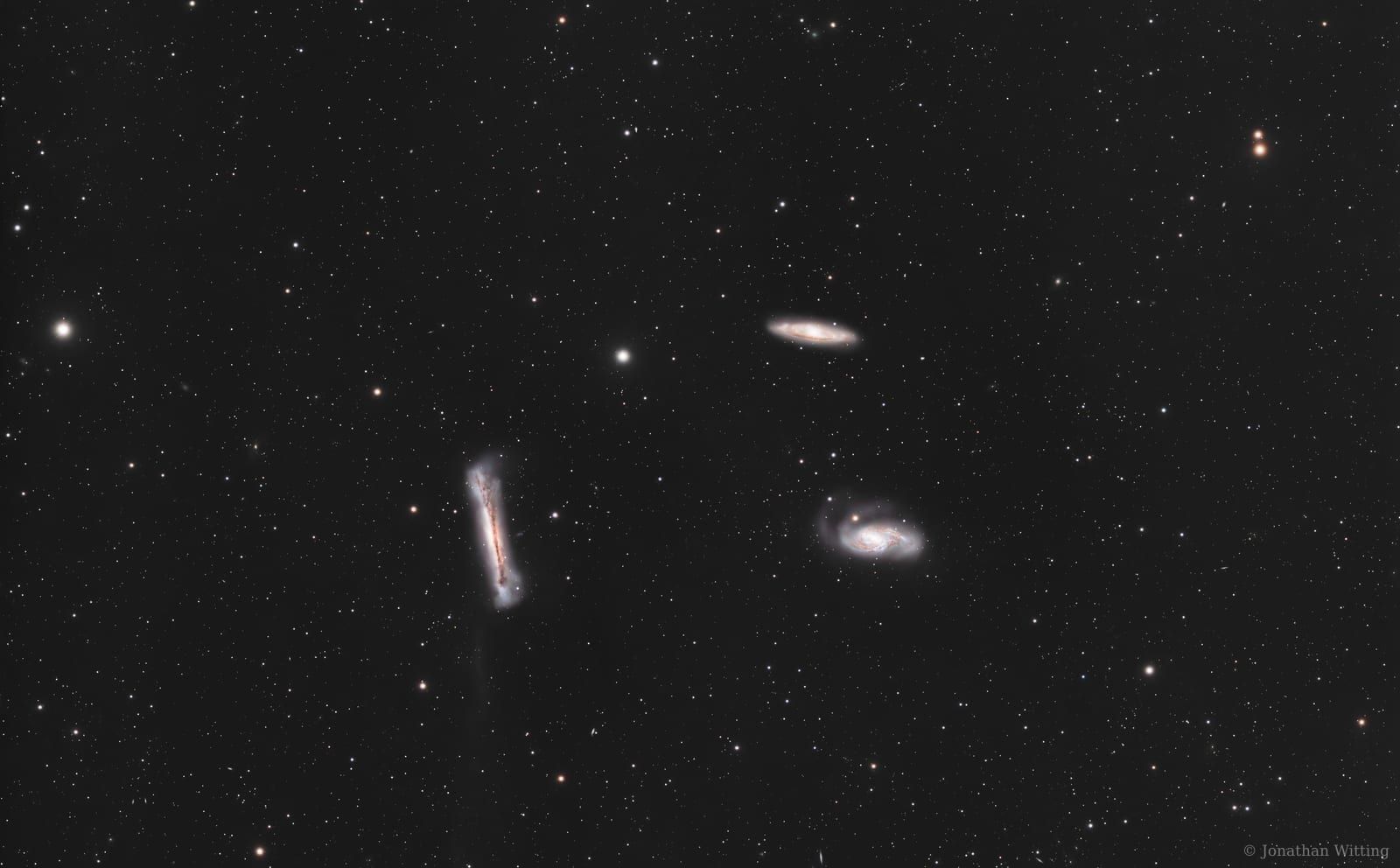
The Leo Triplet is exactly what it sounds like: three spiral galaxies, M65, M66 and NGC 3628, packed into a single small patch of Leo around 35 million light years away. They aren't just neighbours in projection. The three really are interacting, and each wears the evidence differently.
M65 is the tidy one, a relatively undisturbed spiral roughly 94,000 light years across. M66, the largest at around 100,000 light years, shows clear tidal distortion in its asymmetric arms. And NGC 3628, the "Hamburger Galaxy", is seen perfectly edge-on, sliced through by a thick dust lane, with a faint tidal tail of stars stretching away from it: debris flung out by a past close encounter.
The essentials
| Designation | M65, M66 and NGC 3628 (Arp 317) |
| Type | Interacting spiral galaxy group |
| Constellation | Leo |
| Distance | ≈ 35 million light years |
| Apparent size | group spans ≈ 1° (each galaxy ≈ 8′ to 14′) |
| Best season (UK) | February to May |
Why it's a great target
This is the image I'm most proud of since starting out in astrophotography. Three different galaxy presentations (face-on-ish, distorted and edge-on) in one composition is rare, and the triplet sits at a scale that suits a small refractor well: wide enough that all three frame comfortably, close enough that each shows real structure.
It's also a proper galaxy season project. Leo rides high on spring evenings from the UK, in that window when the nights are still dark but the summer nebulae haven't yet returned.
Capture notes
- Framing: at my 382mm focal length the trio fits with pleasing space around it. Rotate the camera so all three sit on a gentle diagonal, and leave room beyond NGC 3628 for the tidal tail. It's there in deep data, and cropping it off would be a shame.
- Filters: straightforward LRGB. There's no strong emission component here, so spend the bulk of your time on luminance.
- Moon: broadband only, so this wants moonless nights. Plan the project around new moon weeks in March and April.
- Integration: I gave this more time than any target before it, over 21 hours of LRGB at 180s, and the extra depth is what brought out the faint structure and the tail. An hour or two shows three smudges; the interaction story only appears with patience.
Processing notes
The challenge is dynamic range across three objects at once: bright cores, mid-tone arms and a tidal tail barely above the sky background. Stretch in stages and use masks so lifting the tail doesn't bloat the cores. Be careful with gradients too, because the faint tail is easily faked or erased by careless background extraction. Budget real time for the pre-processing as well. Calibrating, registering and integrating my set took over four and a half hours in PixInsight before I'd touched a single pixel creatively. A marathon, but worth every minute.