
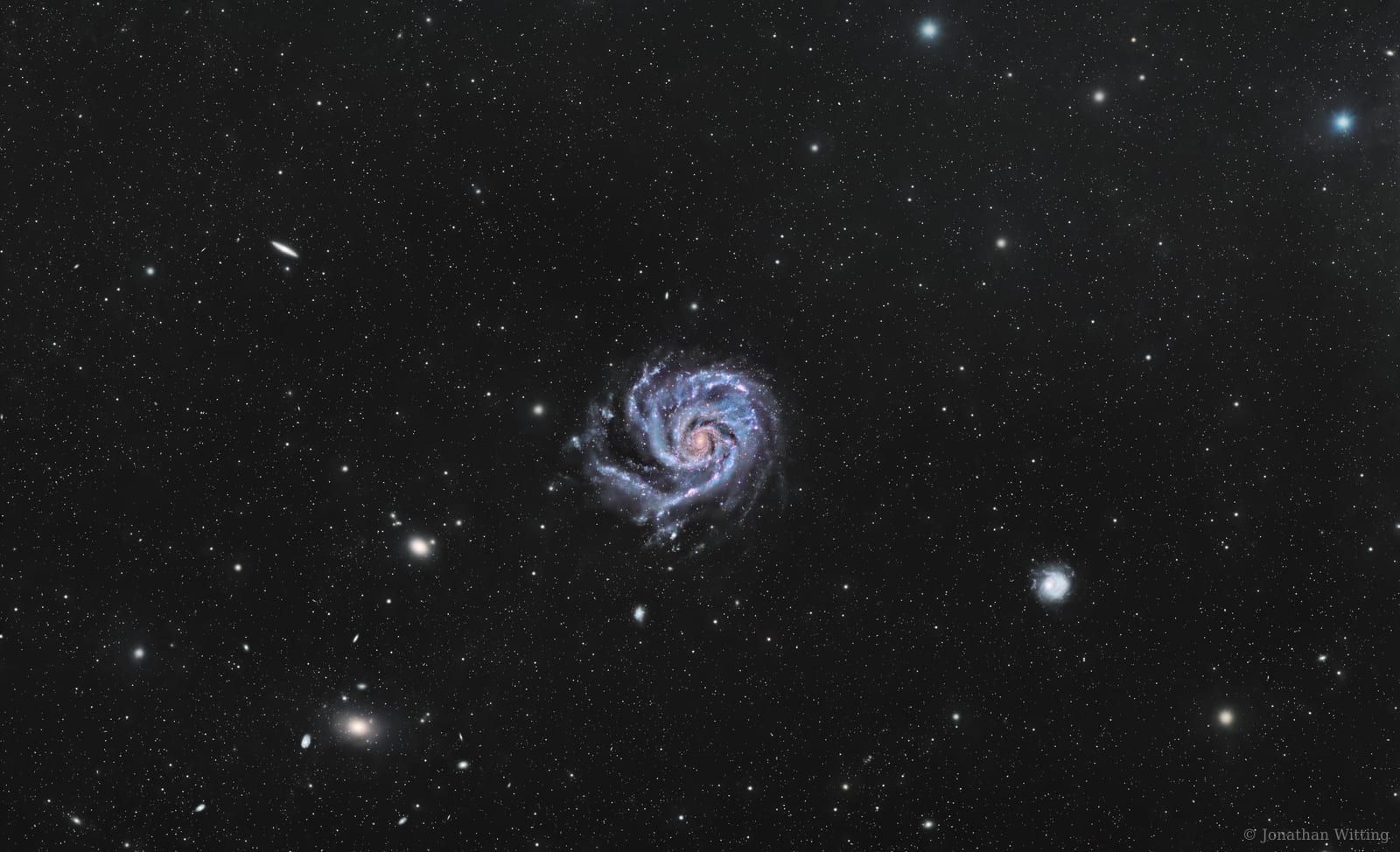
M101 is the galaxy you draw when someone says "spiral galaxy": a grand face-on pinwheel around 21 million light years away in Ursa Major, and at roughly 170,000 light years across it's nearly twice the size of the Milky Way. Because we see it flat-on, nothing is hidden. The arms unwind in full view, studded with knots of pink and red where enormous clouds of hydrogen are collapsing into new stars.
Those star-forming regions are the detail that lifts an image of M101 from good to great. Several are bright enough to have their own NGC numbers, which is a strange thought: catalogued objects that are merely features of another object.
The essentials
| Designation | M101 / NGC 5457 |
| Type | Face-on spiral galaxy |
| Constellation | Ursa Major |
| Distance | ≈ 21 million light years |
| Apparent size | ≈ 29′ × 27′ |
| Best season (UK) | February to June |
Why it's a great target
For a galaxy, M101 is big. At nearly half a degree across it's one of the few spirals that doesn't feel lost in a wide refractor field, and being circumpolar from the UK it rides high through spring, right through galaxy season. The catch is that all that light is spread thinly: the surface brightness is low, and short integrations look disappointingly faint. This is a target that rewards long integration.
It's also a lovely measure of progress. I first shot M101 in 2021 with my old Canon EOS 500D, and came back in 2025 with the mono camera and a plan to go deeper than ever. The difference four years makes is humbling.
Capture notes
- Framing: at my 382mm focal length M101 sits comfortably in the frame with room to spare, so take care with composition: there are several small companion galaxies nearby worth keeping in shot. Longer focal lengths will pull out more arm detail if your guiding allows.
- Filters: LRGB is the core of the image, but add hydrogen-alpha if you can. My 2025 version was HaLRGB (L 129, R 121, G 119, B 120 and Ha 100, all at 180s, 29.5 hours over 8 nights) and the Ha is what makes the star-forming regions pop.
- Moon: broadband galaxy data wants dark, moonless skies. Save the moonlit nights for the Ha subs, which cope far better.
- Go deep: I captured over 40 hours and rejected around a quarter. Be ruthless with sub selection; the faint outer arms only survive in clean data.
Processing notes
Blend the Ha into the red channel (and a touch into luminance) gently. It's seasoning, not the meal, and a heavy hand turns the whole galaxy salmon pink. Stretch carefully too: the core is far brighter than the outer arms, so a masked or multi-stage stretch keeps the centre from blowing out while you lift the faint extremities. Expect to spend a while on it. Processing my 29 hour set in PixInsight was a mission of its own, but easily my most detailed M101 yet.