
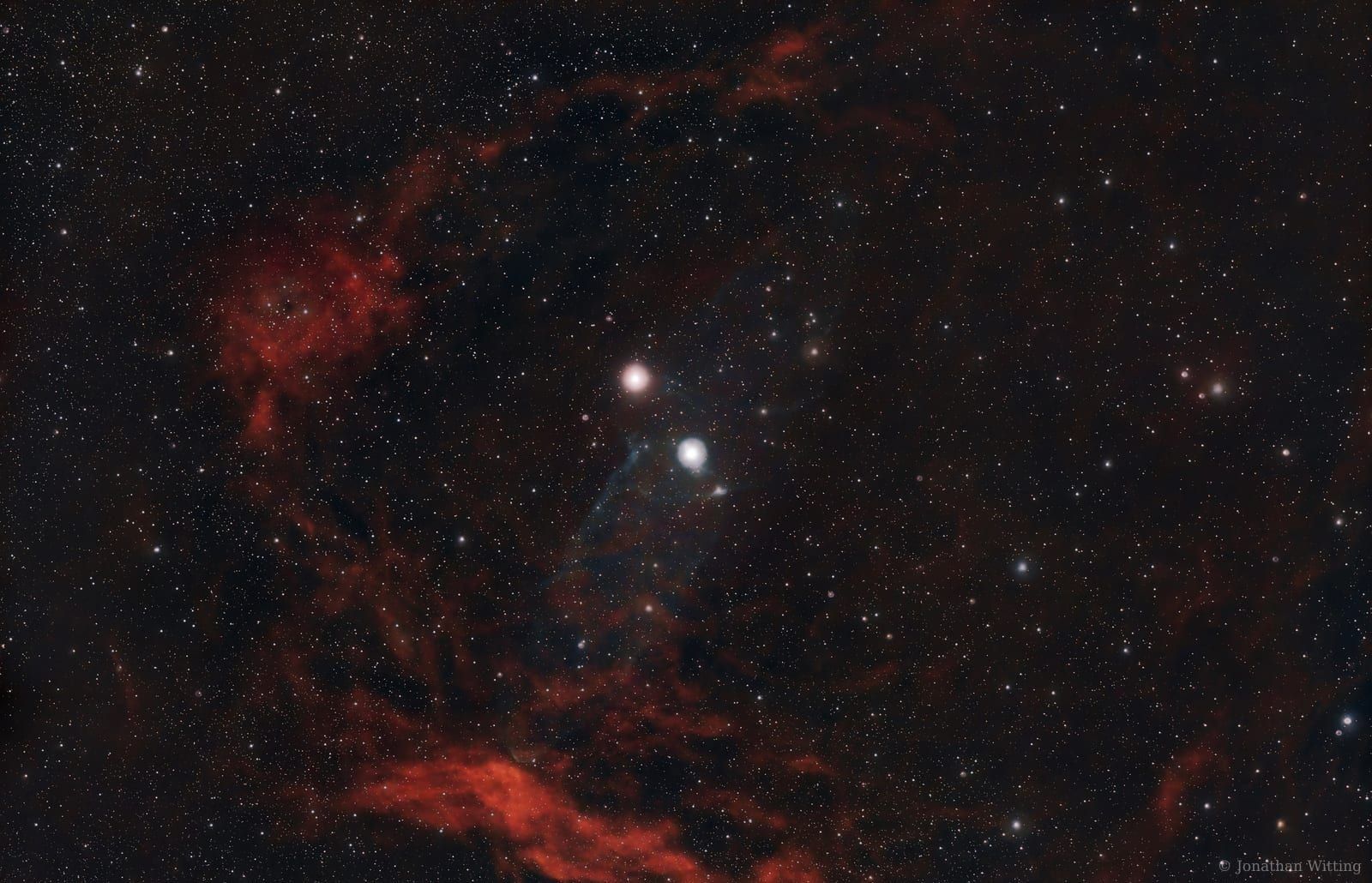
The Squid is a target with a warning label. OU4 is a vast, bipolar streak of doubly ionised oxygen that appears nestled inside Sh2-129, the red emission region nicknamed the Flying Bat, in Cepheus. It was only discovered in 2011, by French amateur Nicolas Outters, which tells you most of what you need to know about its brightness: generations of imagers had photographed Sh2-129 without noticing the squid swimming through it.
Even its distance is uncertain. For years it wasn't clear whether OU4 sits inside Sh2-129 or merely along the same line of sight; more recent estimates place it around 2,300 light years away, likely an outflow from the triple star HR 8119 at its centre, though the debate isn't fully settled.
The essentials
| Designation | OU4 (Outters 4), within Sh2-129 |
| Type | Faint OIII emission nebula (nature debated) |
| Constellation | Cepheus |
| Distance | ≈ 2,300 light years (long debated, estimates vary) |
| Apparent size | ≈ 1° × 0.25° (OU4); Sh2-129 ≈ 2° |
| Best season (UK) | July to November |
Why it's a great target
Partly because it's hard, and because the combination is unique: an electric blue squid suspended inside a red bat, two nebulae in two different emission lines sharing one field. Cepheus is circumpolar from the UK, so you can chip away at it across the whole second half of the year. If you pull it off, you've earned it.
This was the most challenging project I've attempted to date, and I want to be straight about how it went. I threw 135 × 300s at it (11.3 hours) with my one-shot-colour ASI 294MC Pro and the L-eXtreme, selected the subs carefully, and made five separate attempts at processing. The squid was just about visible, but the detail I'd hoped for simply wasn't there. The OIII signal is that faint. My conclusion: this really wants a mono camera with serious, dedicated OIII time, think tens of hours through a narrow OIII filter, and I'll be revisiting it on exactly those terms.
Capture notes
- Framing: at my 382mm field Sh2-129 roughly fills the frame with OU4 centred inside it, which is the natural composition. A shorter focal length gives more context; longer sacrifices the bat for the squid.
- Filters: OIII is everything here. A dual-band filter captures both lines on one-shot colour, but the squid gets only half your photons. Mono with a 3nm OIII filter is the tool the target actually wants.
- Moon: OIII suffers badly under moonlight. Reserve your darkest, most transparent nights for this and shoot the Ha component when the moon is up.
Processing notes
Expect to work for it. Integrate everything, then stretch the OIII far harder than feels reasonable, with aggressive noise reduction held back by masks so the squid isn't smoothed away with the grain. Process the Ha and OIII separately and combine at the end, keeping Sh2-129 subdued so it doesn't drown its lodger. And set your expectations by your integration: under about ten hours, be pleased if the squid is detectable at all.