
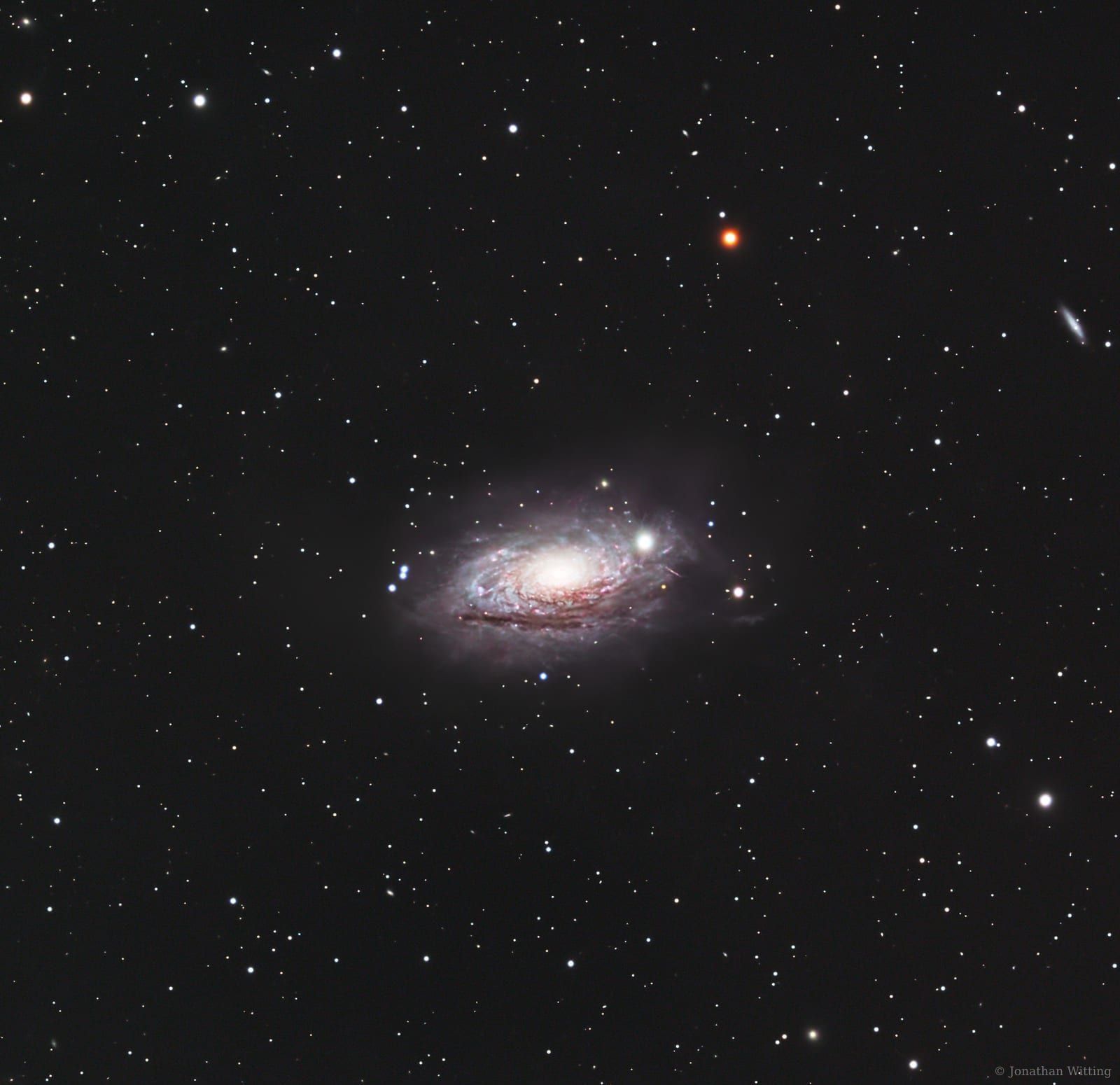
Most famous spirals, like M51 or M101, are "grand design" galaxies with two or three long, sweeping arms you can trace from core to rim. M63 is the other kind. It's a flocculent spiral: instead of continuous arms, its disc breaks up into thousands of short, fluffy segments of star formation, patchy and layered like the petals of a sunflower. That texture is the whole character of the object, and it's where the nickname comes from.
The galaxy sits around 29 million light years away in Canes Venatici, just under the handle of the Plough, and spans roughly 98,000 light years, so it's in the same size class as the Milky Way. It always amazes me that light that left this galaxy 29 million years ago ends up on a sensor in a back garden in southeast England.
The essentials
| Designation | M63 / NGC 5055 |
| Type | Flocculent spiral galaxy |
| Constellation | Canes Venatici |
| Distance | ≈ 29 million light years |
| Apparent size | ≈ 13′ × 7′ |
| Best season (UK) | March to June |
Why it's a great target
M63 is one of the brighter spring galaxies, high overhead from the UK during galaxy season, and its bright core means even modest integrations show a clear, satisfying object. But the flocculent texture is the real prize, and that asks for a bit more depth. This was my first attempt at the target: 7.5 hours of LRGB (L 40, R 30, G 40, B 39, all at 180s), and I was thrilled with how much of that woolly arm structure came through at only 382mm of focal length.
It also makes an ideal mid-sized project. It doesn't demand the twenty-plus hours that something like the Leo Triplet rewards, so it's a great choice when the forecast offers two or three clear nights rather than a fortnight.
Capture notes
- Framing: at my focal length M63 is a small subject in a wide field, so composition matters. Centre it or offset it deliberately; there's also a scattering of faint background galaxies in the area that deep data will pick up.
- Filters: plain LRGB. Weight your time towards luminance, which carries the textural detail that defines this galaxy.
- Moon: broadband only, so wait for moonless skies. Spring haze and high cloud also flatten the subtle disc texture, so be picky about transparency.
- Sampling: at short focal lengths a drizzle integration can help recover some of the fine, clumpy detail if you have plenty of well-dithered subs.
Processing notes
Resist the urge to over-sharpen. Flocculent structure is soft and granular by nature, and aggressive sharpening turns it into noise-shaped mush. A gentle local contrast boost through a galaxy mask does far more for the petal texture than deconvolution pushed too hard. As with most spirals, control the bright core with a masked stretch, and keep the faint outer disc, which extends well beyond the obvious bright region, from being clipped into the background.