
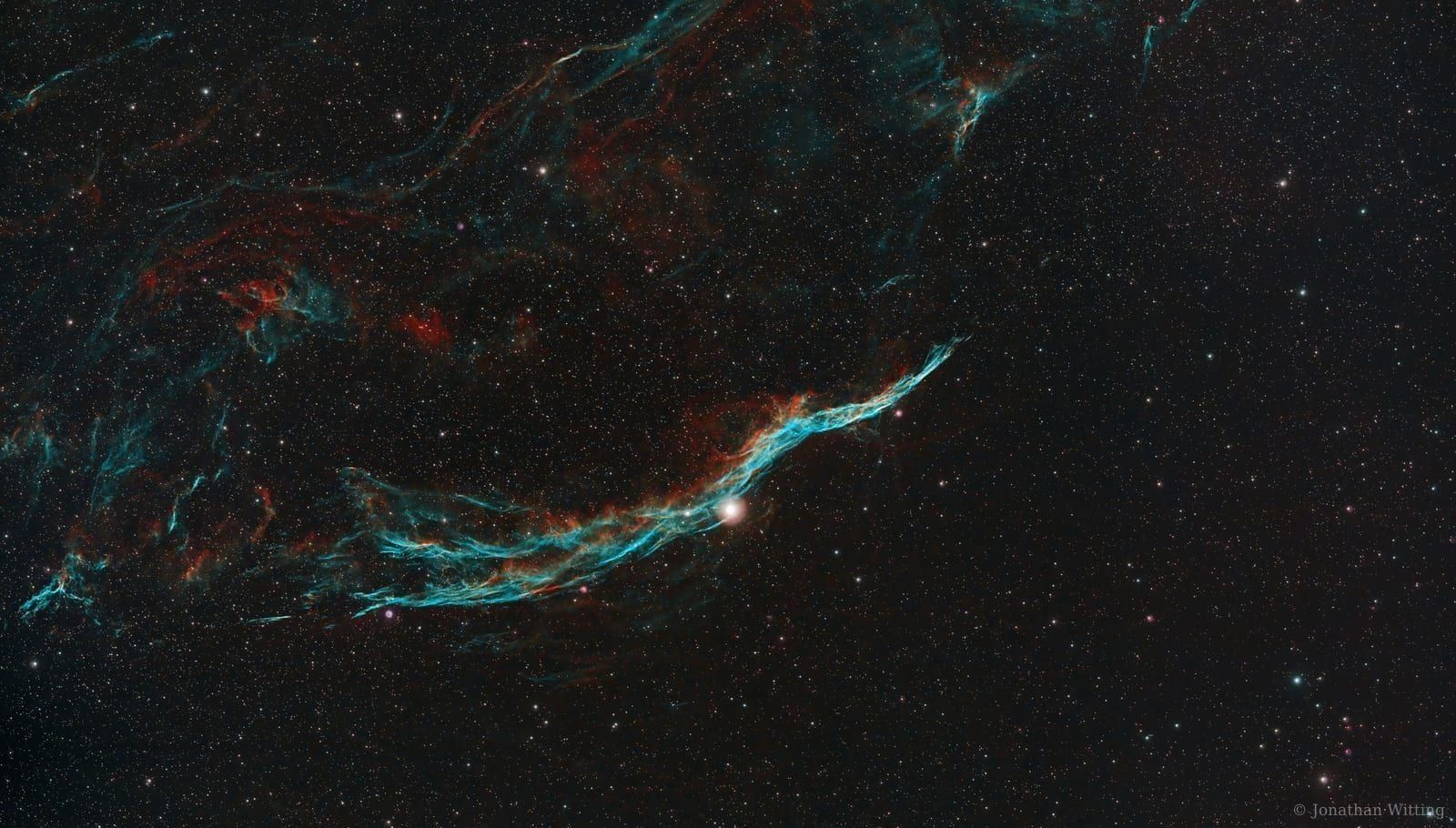
The Veil Nebula is what's left of a star that detonated somewhere between five and twenty thousand years ago. The blast wave is still expanding through Cygnus today, and where it slams into the surrounding interstellar medium it lights up as a vast, delicate lacework of glowing filaments: the Cygnus Loop, around three degrees across.
The western arc, NGC 6960, is the section in the image above. The bright foreground star threaded through the middle is 52 Cygni (visible to the naked eye from a dark site), and the way the nebula appears to stream away from it earned this section its nickname: the Witch's Broom.
The essentials
| Designation | NGC 6960 |
| Type | Supernova remnant |
| Constellation | Cygnus |
| Distance | ≈ 2,400 light years |
| Apparent size | ≈ 70′ × 6′ |
| Best season (UK) | July to November |
Why it's a great target
The Veil is the textbook two-colour narrowband object. The filaments radiate strongly in both hydrogen-alpha (red) and doubly-ionised oxygen (blue-green), and the two don't simply overlap. They trace different layers of the shock front, which is why the nebula shimmers between gold and electric blue. A dual-band filter and a one-shot-colour camera capture both lines in a single integration, making this one of the most satisfying targets for a simple setup.
It's also bright as narrowband objects go. An hour of integration will show the structure clearly; five or more will start pulling out the faint tendrils between the main arcs.
Capture notes
- Framing: at roughly a degree long, NGC 6960 nicely fills a field of around 1 to 1.5 degrees. With a wider field, consider framing it with Pickering's Triangle to the east. A longer focal length rewards you with the fine filament detail instead.
- Filters: a dual-band (Hα + OIII) filter is ideal from light-polluted skies. Broadband-only captures will struggle from the suburbs.
- Moon: narrowband tolerates moonlight well, but OIII suffers more than Hα, so save your moonless nights for the OIII signal if shooting mono.
Processing notes
The classic rendering maps Hα to red and OIII to blue and green (a "bicolour" or HOO palette), which keeps the colours close to what the eye would see. Keep the stars under control. This region of Cygnus sits in a dense star field, and a star reduction pass (or full star removal before stretching) makes an enormous difference to how clearly the filaments read.