
After almost three months of patiently waiting, some clear(ish) skies finally arrived and gave me the chance to capture first light with my new planetary camera, the ASI 662MC. It took a while to get there, mostly thanks to one stubborn problem: back focus.
My telescope is the Zenithstar 81 from William Optics, a refractor, and according to its diagram it requires 150.05mm of back focus without a field flattener or reducer in place. That's quite a lot. I had to make sure I had enough spacers fitted, working in conjunction with the focuser itself, so that the camera sensor would sit on exactly that plane. Then, just to complicate matters, introducing a Barlow pushed the requirement back a little further still.
I should say up front that a refractor like this doesn't have the greatest focal length for planetary work, so it's never going to be the ideal scope for the job. For lunar imaging though, it works quite well, and since the planets aren't well placed at this time of year anyway, the Moon was the obvious target.
Solving the back focus puzzle came down to good old trial and error. I set everything up during the day and focused on a neighbour's roof, five or six houses away from mine, simply because it was the most distant thing I could practise on. What I ended up with was the telescope's focuser racked out a fairly decent amount, plus a stack of extenders attached to part of my modular Barlow. I used the Baader Hyperion modular Barlow with the front piece removed, inserted that into the focuser, then attached it directly to the camera. The 150mm is effectively split between the two: partly made up by the extenders, partly by the focuser travel on the telescope itself. With the Barlow pushing the requirement back further I did end up going beyond the 150mm, but it was close enough to get me started.
With the mechanical fiddling out of the way, I could finally get to imaging. Naturally, the conditions decided not to cooperate. The seeing wasn't great, and you can see in the capture footage that the atmosphere was distinctly wobbly, which had a real impact on what I could produce. It was also quite windy and the Moon was dipping low, none of which helped the situation. If you'd like to see the back focus setup in detail and judge the wobble (and the results) for yourself, it's all in the video above, and a subscribe on YouTube means you'll catch how this camera gets on from here.
Of the two images I came away with, I was very happy with the second one. The first, not so much, as by that point the weather really wasn't conducive to a good, high quality, precise image. But at least the camera got out there and showed me what it could do.
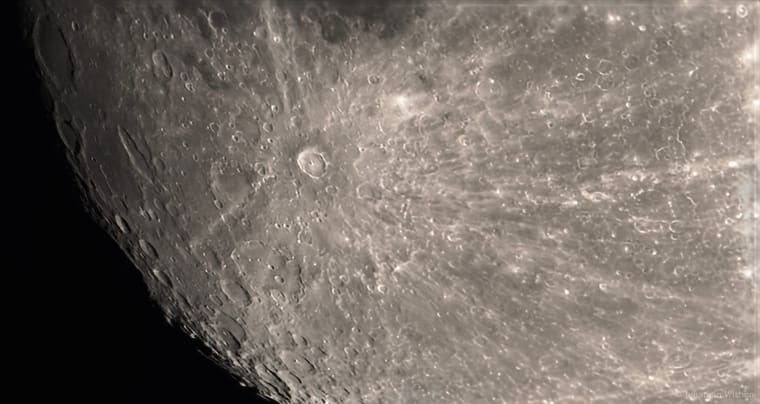 The MoonWilliam Optics Zenithstar 81 APO · ZWO ASI 662MCView in gallery →
It's clearly capable of producing some really high quality images; as with all things astrophotography, it's just down to finding the right nights. I'll have another go at the planets later in the year, and in the meantime I'll keep pointing it at the Moon whenever the skies allow.