
I have some exciting news to share: I've made the leap from one-shot colour to mono. It's a big transition and a big upgrade, and in this post I want to explain why I did it, what I bought, and how the first test shots and first proper image turned out.
For reference, the full rig now looks like this:
- ZWO ASI 2600MM Pro (+ Antlia Sii, Ha, Oiii & LRGB-V Pro Filters)
- ZWO ASI 662MC
- William Optics Zenithstar 81 + Sky-Watcher HEQ5 Pro
- William Optics 50mm Slide-base Uniguide Scope + ZWO ASI 120mm Mini
- ZWO ASIAir Pro
Why move from one-shot colour to mono?
After about three years with the ASI 294MC Pro, a one-shot colour camera, I decided it was time for a change. One-shot colour cameras are great, but they're a jack of all trades and master of none: very easy to use, very time efficient, point and click and you have data across the whole red, green and blue spectrum. The trouble is that for certain targets, nebulae being the obvious example, you don't actually want everything in that spectrum. You want to narrow down the wavelengths you capture and ignore the rest. I'd been using an Optolong L-eXtreme multi-bandpass filter over the colour camera, which worked well for cutting through light pollution, but mono with individual filters gives much finer control over exactly what you're capturing.
There's a second benefit too. A colour camera has a Bayer pattern on the sensor, a grid divided into red, green and blue wells (with more green than anything else, because the everyday world has more green in it). Photons that land on the wrong part of the grid simply don't register. With a mono camera, everything that passes through the filter and hits the sensor gets captured, so in theory you're collecting roughly three times more data. The trade-off is time and planning. To build an RGB image you have to shoot separately through red, green and blue filters, more than likely a luminance filter too, and for narrowband you do the same again with hydrogen alpha, oxygen III and sulphur II. That means a filter wheel (or manually swapping filters) and multiple imaging runs, but the quality of the data should be superior. That was my rationale, anyway.
The camera, the wheel and the filters
I spent a while weighing up the options and was on the verge of buying the mono equivalent of my existing camera, the 294MM Pro, before deciding to invest a bit more and move up the ZWO range to the ASI 2600MM Pro. Compared with my 294MC Pro it offers higher resolution (around 6,200 x 4,170 pixels versus roughly 4,100 x 2,800), lower read noise, smaller pixels (3.76 versus about 4.63 on the 294), marginally higher quantum efficiency (around 80% versus 75%) and 16-bit dynamic range rather than 14-bit, meaning more variation between light and dark. All around a pretty big (and pretty expensive) upgrade, but one I'm hoping will stand the test of time and keep me happy for a very long time.
Of course, the camera alone isn't enough, which is why this was such a significant investment. For filter control I went with the ZWO 36mm filter wheel, which holds seven filters: my LRGB set plus Ha, SII and OIII. I'll probably cover the installation separately, because honestly it's a little daunting; getting expensive filters in the right way around without fingerprints or grease marks is nerve-racking.
The filters themselves were a big chunk of the cost, and I hadn't appreciated quite how expensive they can be. Chroma and Astrodon were far beyond what I was prepared to pay, but having invested so much in the camera I didn't want to go too cheap either, so I looked for a good middle ground and settled on Antlia. I bought their LRGB set plus the 3nm narrowband filters for sulphur II, oxygen III and hydrogen alpha, all of which consistently get good reviews. My one hesitation was star halos: some people get halos with the OIII filter and some don't, and it seems to come down to the batch you receive. Fingers crossed.
Testing for halos
Before any proper imaging I ran a quick test, partly to check the filters were the right way around in the wheel, but mainly to look for haloing, particularly with that OIII filter. I took a 60-second exposure of Arcturus, a very bright northern hemisphere star, through each narrowband filter in turn. Sulphur looked good with no obvious halo (I wasn't too worried about that one anyway), hydrogen alpha was the same, and the OIII, the one I was most concerned about, also looked pretty good. I'll get a better sense once I'm stacking lots of exposures, but it's a promising sign that I've got a good batch.
First light: Bode's Galaxy in LRGB
It's galaxy season, so for first light I captured some LRGB data on a target I've shot before but not visited for a couple of years: Bode's Galaxy, M81. The stacked luminance frame looks really promising. There's a slight cast to deal with and a few satellite trails that haven't been fully removed, but the detail is good and the stars are round, even in the corners, which suggests I've sorted my back focus and the filters are performing well. The red, green and blue frames all look similarly healthy.
And here it is, my first light image of M81 with the ASI 2600MM Pro and Antlia filters:
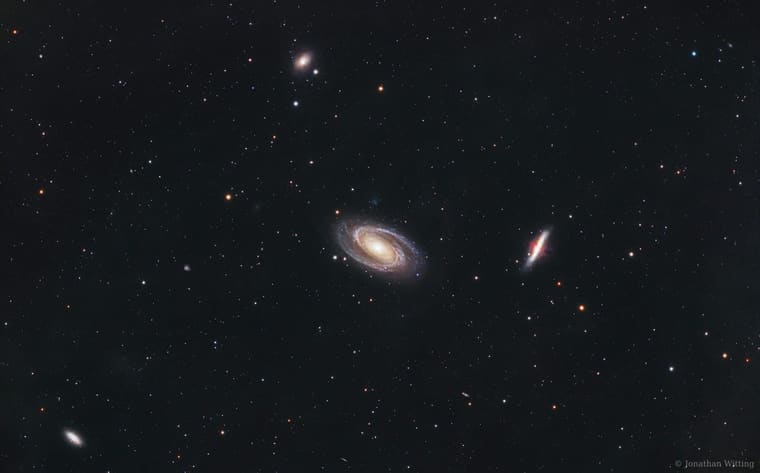 Bodes Galaxy5h · William Optics Zenithstar 81 APO · ZWO ASI 2600MM ProView in gallery →
The full unboxing and the test frames are in the video above, so do give it a watch and consider subscribing on YouTube if you'd like to see how I get on with mono. So far, I'm fairly confident this was the right call. Clear skies!