It's been a couple of months since my last video, and there's a good reason for the silence: rather sensibly (or not), I decided to take on two projects instead of one. The result is that I finally have my first two SHO narrowband images with the ASI2600MM Pro to share, the Elephant Trunk Nebula and the Cygnus Wall.
For anyone curious, this is the kit I used:
- ZWO ASI 2600MM Pro (+ Antlia Sii, Ha, Oiii & LRGB-V Pro Filters)
- ZWO ASI 662MC
- William Optics Zenithstar 81 + Sky-Watcher HEQ5 Pro
- William Optics 50mm Slide-base Uniguide Scope + ZWO ASI 120mm Mini
- ZWO ASIAir Pro
At the end of the last video I promised I'd go after some nebula targets using the filters I hadn't tried yet, the SHO set, that's sulphur II, hydrogen alpha and oxygen III. I didn't want to settle for a single night per target either. The plan was to gather a decent amount of data on each one, building up a composite image over multiple nights with far more depth to it than a one-night effort could manage.
The two targets I settled on were the Elephant Trunk Nebula and the part of the North America Nebula known as the Cygnus Wall. Neither is exactly ideal at this time of year in the UK; both sit relatively low in the sky and it's arguably still a bit early in the season for them. But I decided to have a go anyway, picking the nights with the best possible weather and gathering as much data as I could.
The capture, and a guiding mystery
In the end I managed to get the telescope out for three nights on each target. The Elephant Trunk yielded about 15 hours of data in total, which came down to just over 12 hours once I'd stripped out the lower quality subframes. The Cygnus Wall was a similar story, three nights again but closer to 19 hours captured.
Unfortunately the Cygnus Wall data also suffered some guiding issues, particularly after the meridian flip, where I noticed some fairly prominent star trails. I lost a huge amount of data to it, pulling the usable total back to about 12 hours as well. My working theory is a little slippage in the filter wheel. It wasn't as tight as it could be, and after the meridian flip it may have been pulling ever so slightly and knocking the guiding off. I've since tightened everything up and tidied all the cables with cable ties, so the rig is as lean and neat as I can make it, but I won't know for sure until I test it next time out. Losing that much data is really frustrating given how few clear nights we get, so if you've got other ideas about the cause I'd love to hear them. It only happens in one half of the night, so I'm convinced it's flip-related.
Looking at the stacks
In the video I go through the stacked masters for the Cygnus Wall (the Elephant Trunk stacks aren't that dissimilar, so I didn't repeat the exercise). Everything was stacked with full calibration, dark frames, flat frames and dark flats, and I drizzled the data too, which I think made quite a big difference given how much of it I had.
The sulphur II stack came out nicely after a quick stretch. There's lots of detail and the stars are mostly round, though a few show a little elongation which I suspect is an artefact of that meridian flip guiding issue. I dropped as many of the elongated subs as I could, but a few slightly egg-shaped stars survived the cull. Noise levels look good, even in the corners, and all the nebulosity I was hoping for is there.
The oxygen III stack really impressed me, and that's straight out of stacking with no other processing applied. The contrast is lovely, the detail it pulled out is great, and the corner stars are no worse than the centre. I captured a lot of OIII data and it really came through. There's even one structure side-on that looks rather like a face, which I love. Thoroughly chuffed with this one.
Hydrogen alpha was clean too, not particularly noisy, with the same minor star caveats and a really good amount of detail running through the wall itself. It contributed in a significant way to the final combined image.
What's next
I haven't decided on the next target yet. It will probably be another nebula, but I haven't been able to get the telescope out since capturing these two. We've had some decent sunny weather lately, yet somehow not a single night clear enough for astrophotography. Typical. I'm hoping something comes along soon and I'll share updates when it does.
And here are the finished images themselves. First the Elephant Trunk Nebula:
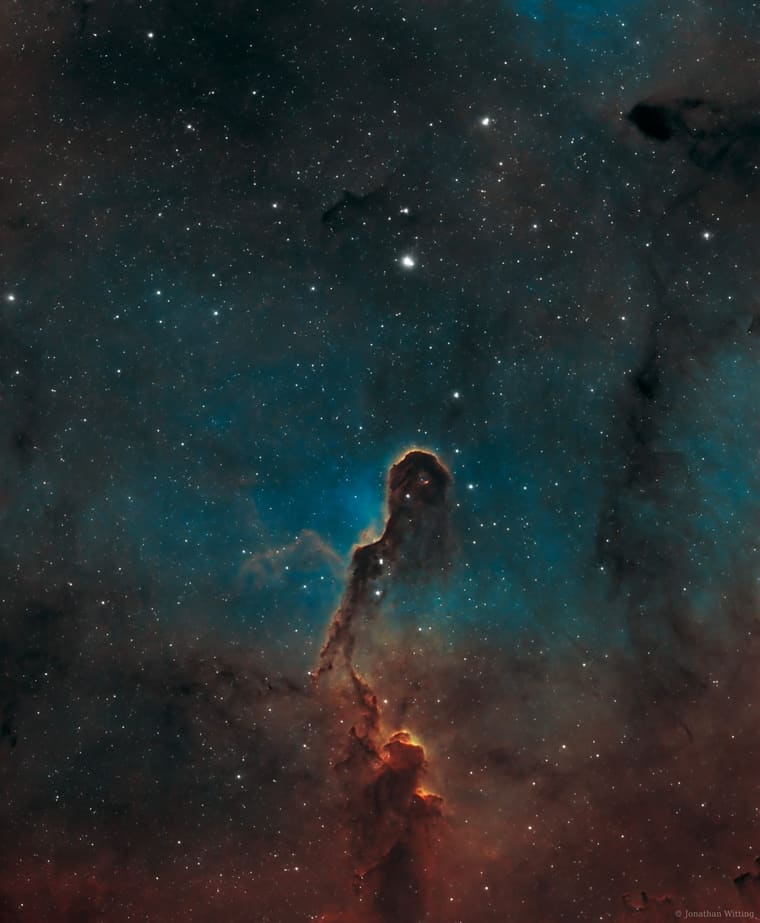 Elephant Trunk Nebula12h 18m · William Optics Zenithstar 81 APO · ZWO ASI 2600MM ProView in gallery →
And the Cygnus Wall:
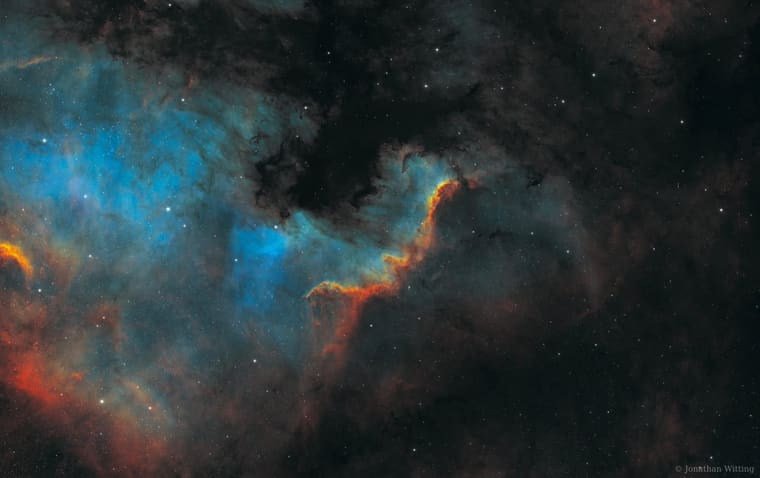 Cygnus Wall12h 48m · William Optics Zenithstar 81 APO · ZWO ASI 2600MM ProView in gallery →
The full story of both captures, along with the setup from the night, is in the video above, so do have a watch. Clear skies!