
With galaxy season in full swing and a rare clear night on the cards, I've been out with the telescope again. This time I had another go at the Whirlpool Galaxy (M51), one of my favourite targets, using a technique that's new to me (HaRGB) and my new mono camera, the ASI 2600MM Pro.
For anyone curious, my equipment for the session:
- ZWO ASI 2600MM Pro (+ Antlia Sii, Ha, Oiii & LRGB-V Pro Filters)
- ZWO ASI 662MC
- William Optics Zenithstar 81 + Sky-Watcher HEQ5 Pro
- William Optics 50mm Slide-base Uniguide Scope + ZWO ASI 120mm Mini
- ZWO ASIAir Pro
Every image I see of the Whirlpool Galaxy captivates me. It's such a beautiful galaxy and such an iconic part of the night sky. I've captured it once before in one-shot colour, so this year I wanted to try something different: imaging it in HaRGB with the mono camera, using the hydrogen alpha data to bring out those Ha regions in the spiral arms and really make them pop.
I managed a full night of data, somewhere around five to six hours in total, shot in 180-second subs spread across the Ha, red, green and blue filters. Spread four ways, that works out at only an hour and a bit per filter, which is less than I'd like, but it was the best I could do in a single night.
A short detour into spirals
After the imaging was done I was out doing some gardening when a snail caught my eye, and it set me thinking about spirals. A snail shell is a pretty perfect spiral structure on a tiny scale, and the same pattern repeats throughout the universe: draining water, tornadoes and hurricanes, spiral staircases, plants and flowers, all the way up to some of the largest known structures, galaxies. I went down a bit of a rabbit hole reading about logarithmic spirals and the golden ratio, often following the Fibonacci sequence, and galaxies are no different; whether it's Bode's Galaxy or the Whirlpool, they follow that same logarithmic spiral shape. A random side thought, I'll admit, but it rather blew my mind how the same pattern repeats across such wildly different scales.
The stacks, filter by filter
With everything stacked, I had a look at how the individual channels came out.
The Ha stack, as expected, doesn't show a huge amount, but there's a decent level of detail in the spiral arms coming through, somewhat patchy, exactly as I anticipated. Those patches are what make the image pop once blended in. The stars look pretty good too, even out towards the corners.
The red channel is really nice. There's a good amount of detail in the 180-second subs, you can make out the dust lanes in the spiral arms, the image is clean and the stars are round. I'm really quite happy with it. Green and blue are a similar story: good detail and decent stars, though a few stacking artefacts crept in, including the remnants of some satellite trails. Honestly, that's just down to the limited amount of data per filter; with more integration time they would average out.
My telescope, with the 0.8x focal reducer fitted, comes down to about 450mm of focal length, so capturing the Whirlpool at all is pushing the limits of what it's capable of, especially for fine detail. The stacks shown are already cropped in and stretched, and anything smaller than this target I tend to avoid. But I love M51 too much not to try it again with the new camera.
Processing
For the processing I followed Sarah's HaRGB galaxy tutorial, or a variation of it, dipping in and out of the tools and techniques she uses. Coming to mono for the first time made me a little nervous as I hadn't much experience with it, and her guide is easy to follow and goes into a really good level of detail, so I highly recommend it: Sarah's galaxy processing tutorial. From there I leaned on my past experience processing one-shot colour images to finish the combined HaRGB result, and I was really pleased with how it turned out:
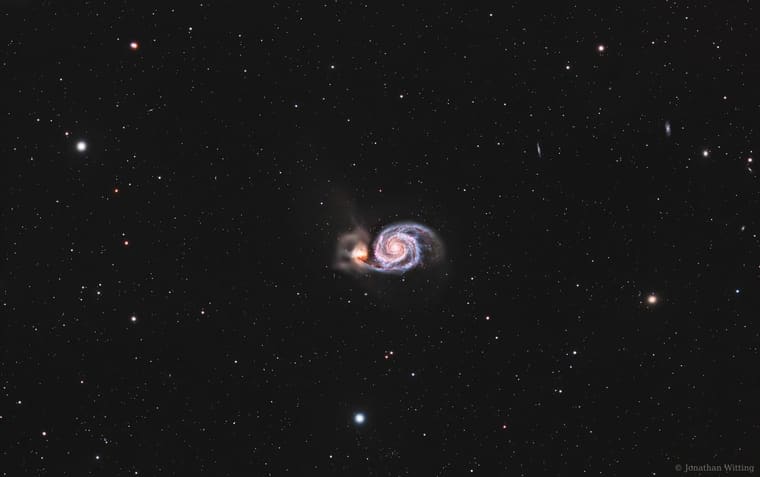 Whirlpool Galaxy6h · William Optics Zenithstar 81 APO · ZWO ASI 2600MM ProView in gallery →
The whole processing session is in the video at the top of this post, so do have a watch.
What's next
The next project is a bigger one: a multi-night capture aiming for somewhere between 10 and 20 hours of data using my SHO filters, sulphur, hydrogen and oxygen. Apart from a quick test on a single star to check for halos and confirm I hadn't installed the filters the wrong way round, I haven't used them yet. It will be a nebula image, not the ideal time of year for it, but I can just about manage something from the garden, and I have three hopefully clear nights coming up, one per filter. Fingers crossed the weather plays ball for once. Clear skies!