
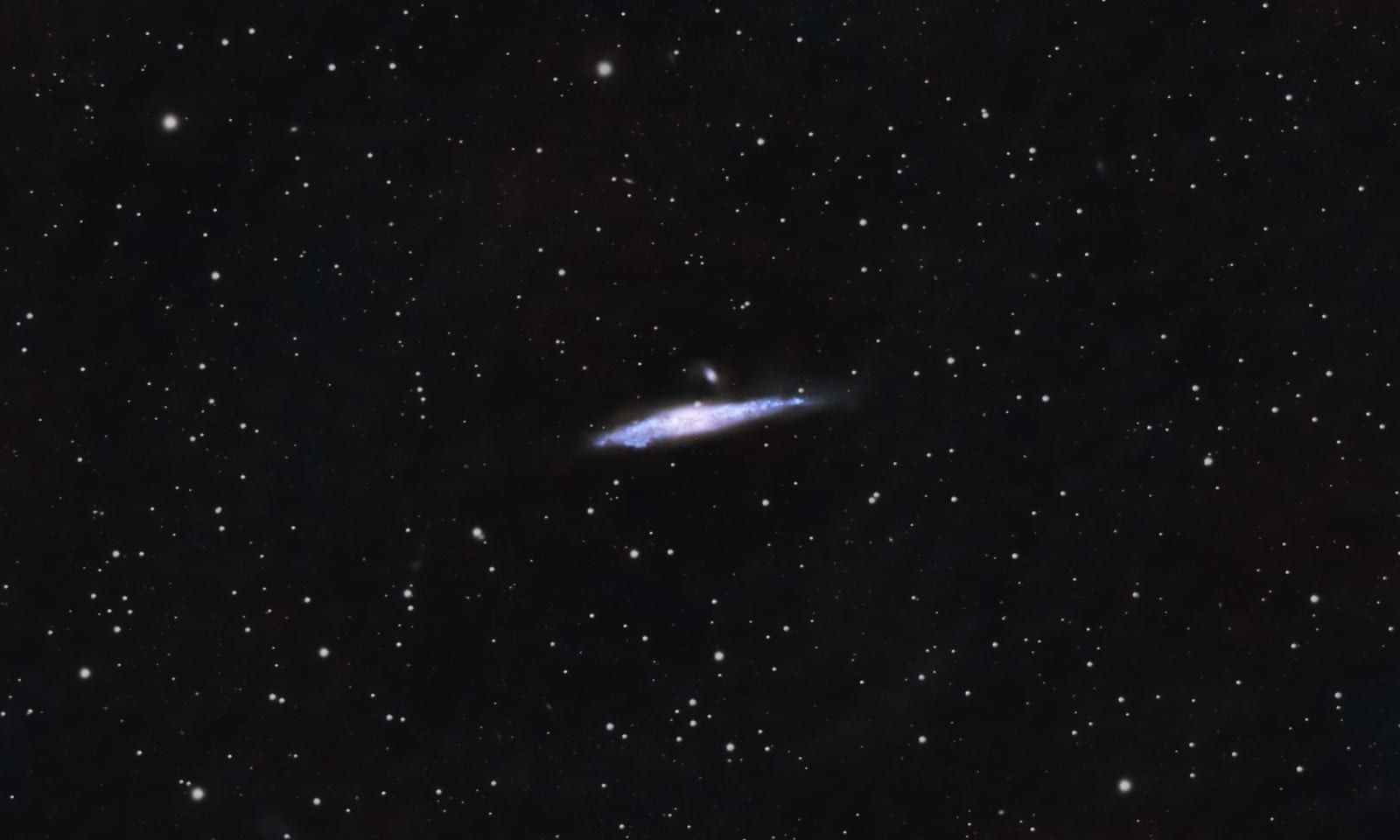
The U.K. has many bank holidays in the first half of the year and more often than not it feels like we end up with dreary weather on those specific days. Not this time though.
The Spring Bank holiday turned out to be glorious weather and gifted me three consecutive nights of clear skies - what a treat! To make the most of it I decided to take on a new target that I’ve never imaged before.
As usual, I consulted the Sky Safari app for inspiration and to figure out what would be feasible. Most targets around the zenith at this time of the year are galaxies, some of which I’ve imaged before (Bodes galaxy, the Whirlpool galaxy, etc.).
There were a couple that jumped out as good potential candidates this time around; the Sunflower galaxy (M63) and the Whale galaxy (NGC4631). As you can probably guess by the title of this post I opted for the latter. I’d love to say I have a good reason for it but the reality is I don’t. They’re both a similar magnitude, both in an ideal position for imaging and both are new targets to me. In the end I just had to randomly pick one. The other I’ll definitely return to another time so stay tuned for that at some undefined point in the future.
The Whale Galaxy is a large spiral galaxy, not that dissimilar to our own Milky Way. Situated in the constellation Canes Venatici, roughly 25 million light years from Earth we see it from a side on perspective. In it's centre a noticeably brighter core in intense star formation occurs. The galaxy is not alone though, it belongs to a galaxy pair with its companion in the form of a dwarf elliptical galaxy, NGC4627.
Around early evening I began the usual sequence of setting up the mount, levelling it, adding the telescope and other gear before proceeding to make sure everything was balanced. Fast forward several hours to around 10pm when darkness set in and I revisit the setup and started the second sequence. This involved a polar alignment, slewing over to the Whale galaxy, ensuring it was in focus and kicking off auto guiding. The final step was to configure the imaging sequence which I opted for 150 x 120s exposures.
A couple of minutes later the first exposure rolled in and everything was looking good. The Whale watching had begun and would continue for the next 5 hours. At this stage there was nothing more for me to do so I let the equipment do its job and I retired for the evening.
The following morning, I did a quick review of the data to check everything looked alright. As expected the target had dropped behind the roof of my house towards the end of the imaging session meaning I captured about 30 minutes less data than I’d planned. No big deal though, I knew it was a likely outcome.
With the review complete I moved on to capture the ever-important calibration frames - flats and dark flats. Normally this is where I’d stop, however I also opted to run the camera for a while longer and replace my library of dark frames since they were roughly 18 months and were due a refresh.
The following two nights I repeated the same steps, albeit a lot quicker as I decided to leave the mount in situ.
In the end I managed to gather just shy of 13 hours of data on the Whale galaxy. A sizeable haul and one I was very pleased with. The resulting image I created using PixInsight, stacking the images using the weighted batch pre-processing script before going through my galaxy processing workflow (which definitely needs work).
For a very small magnitude target taken through my telescope with a not insignificant focal length, but definitely a restrictive one I think the resulting image is relatively decent. If I eventually add an extra telescope to my collection that has a much larger focal length I'll reattempt this again. For the time being I'm happy enough with the results.