
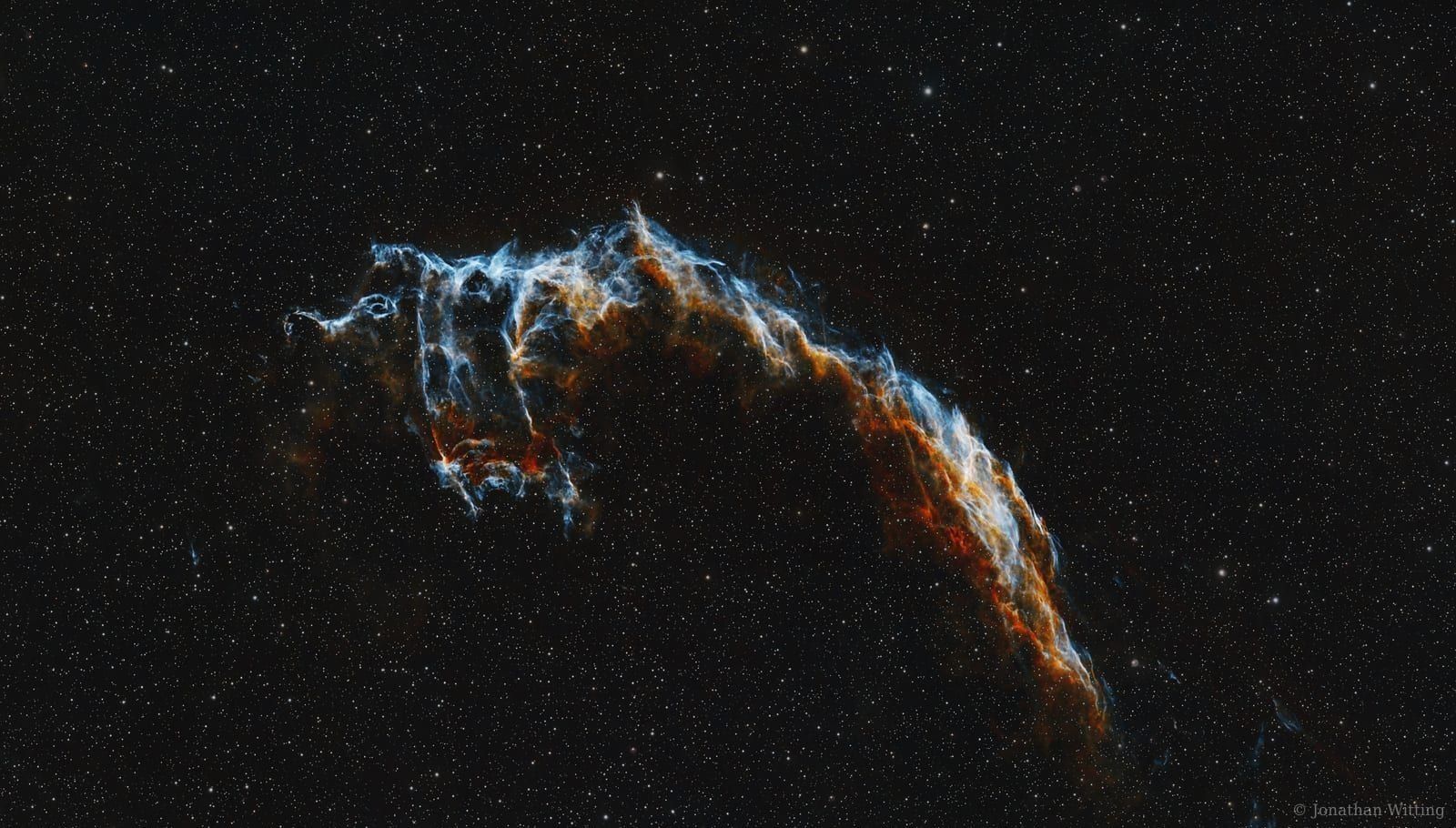
The Eastern Veil is the other half of one of the great showpieces of the northern sky. Several thousand years ago a massive star in Cygnus exploded, and the shock wave from that supernova is still ploughing outwards through the surrounding gas. Where it hits, the gas lights up in glowing filaments: the Cygnus Loop, a circle roughly three degrees across. The eastern arc, catalogued as NGC 6992 along with NGC 6995 and IC 1340 at its southern end, is the brightest section of the whole structure, a sweeping curtain of braided red and blue-green strands around 50 light years across.
If you've read my guide to the Western Veil, the Witch's Broom, this is its sister arc on the opposite side of the loop. The eastern side is brighter and more densely textured, which makes it the better starting point of the two.
The essentials
| Designation | NGC 6992 / NGC 6995 / IC 1340 |
| Type | Supernova remnant |
| Constellation | Cygnus |
| Distance | ≈ 1,500 to 2,400 light years (estimates vary) |
| Apparent size | ≈ 75′ × 25′ |
| Best season (UK) | July to November |
Why it's a great target
Like the western arc, this is a textbook dual-band object. The filaments glow strongly in both hydrogen-alpha and doubly-ionised oxygen, tracing different layers of the shock front, so the nebula renders in interleaved gold and electric blue rather than a single flat colour. It's bright for a narrowband target too: even a modest integration shows the main arc clearly, and more time keeps rewarding you with fainter wisps trailing off into the loop.
Capture notes
- Framing: at my 382mm focal length (f/5.9) the eastern arc fits comfortably with room to breathe, and careful framing catches the fainter tendrils spilling west towards the centre of the loop. A wider field can take in the whole Cygnus Loop; a longer one picks apart the individual braids.
- Filters: a dual-band (Hα + OIII) filter is the way in from suburban skies. I shot mine with the Optolong L-eXtreme on the ASI 294MC Pro: 50 × 300s, a little over four hours, and that was plenty for a satisfying result.
- Moon: narrowband copes with moonlight, but the OIII signal suffers first, so keep your darkest nights for this one if you can.
Processing notes
The standard HOO bicolour palette (Hα to red, OIII to blue and green) suits the Veil perfectly, and star reduction is near essential in this dense Cygnus star field. One lesson from my own experience: keep your raw data. I captured this in September 2021, then reprocessed the very same stack in 2023 with two more years of processing skill behind me, and pulled out noticeably more filament detail. Your data doesn't expire; your technique just catches up with it.