
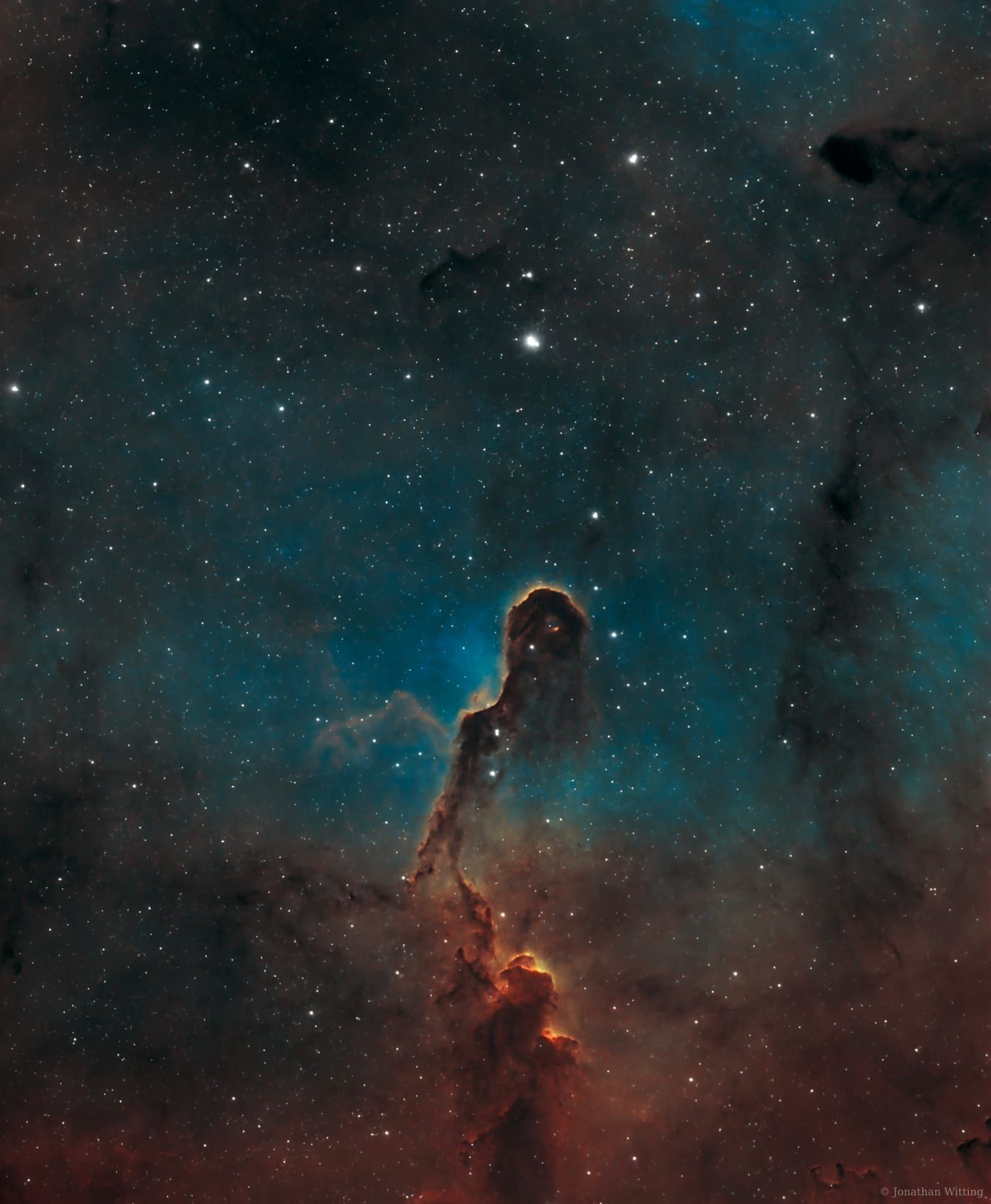
IC 1396 is a huge region of glowing hydrogen in Cepheus, around 2,400 light years away and spanning some three degrees of sky, energised by a fiercely hot multiple star near its centre. The famous feature snaking through it is IC 1396A, the Elephant's Trunk: a long, dark rope of dense gas and dust, its rim lit up where radiation from that central star is boiling its surface away. The trunk is a globule being eroded in real time, and inside its shielded interior new stars are forming.
That contrast, a dark sinuous pillar with a glowing edge set against a bright emission backdrop, is what makes the image. It's pure narrowband country.
The essentials
| Designation | IC 1396 (the trunk is IC 1396A) |
| Type | Emission nebula with dark globule |
| Constellation | Cepheus |
| Distance | ≈ 2,400 light years |
| Apparent size | ≈ 170′ × 140′ (trunk ≈ 30′ long) |
| Best season (UK) | July to December |
Why it's a great target
This was my first ever narrowband target, shot in 2024 just after I moved to a mono camera, and I'd recommend it to anyone making the same jump. The Ha signal is strong and forgiving, the trunk gives you an obvious subject to compose around, and the region responds beautifully to the SHO palette. Cepheus is also circumpolar from the UK and passes nearly overhead, so it's available from midsummer right through to the end of the year.
Over three nights I captured more than 15 hours and kept 12 hours 20 minutes after rejecting the weaker subs: Ha 31, Sii 50 and Oiii 67, all at 300s. Note the weighting. Sii and Oiii are far fainter than Ha here, so they got the lion's share of the time, and I'd weight them even harder if I went back. I covered that first SHO session, and what I learnt from it, in my first light in SHO with the ASI2600MM Pro write-up.
Capture notes
- Framing: the full IC 1396 region is far bigger than the trunk. At my 382mm focal length I frame the trunk as the centrepiece with plenty of the surrounding nebulosity for context; shorter focal lengths can take in the whole circular region, including the garnet-red star Mu Cephei at its edge.
- Filters: 3nm narrowband if you have it. The fine rim detail along the trunk lives or dies on contrast, and tight filters protect it from light pollution and skyglow.
- Moon: very moon-tolerant in Ha and Sii. Save your darkest skies for Oiii, which is the weakest signal in this region.
Processing notes
SHO processing here is a balancing act between the golden Ha/Sii background and the bluer Oiii, and the trunk only reads properly if the dark globule stays properly dark, so don't lift the shadows chasing faint signal. Remove the stars before stretching: this is a dense Milky Way field, and the nebula's structure is unreadable underneath them. As a first narrowband project it taught me more about processing than any target before it, and it's still one I plan to revisit with more experience behind me.