
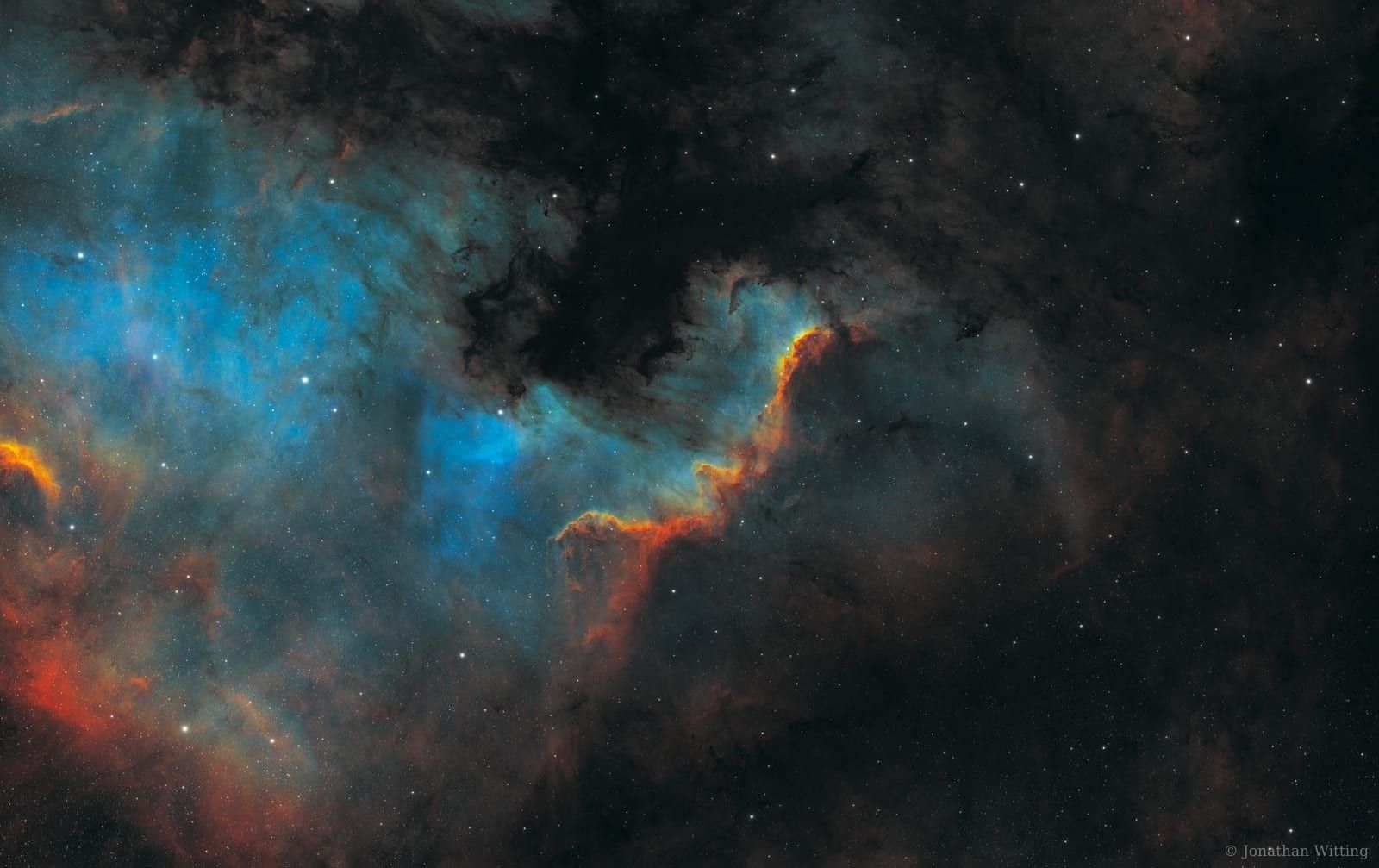
The North America Nebula earns its name. This enormous emission region in Cygnus really does trace the outline of the continent, complete with a Gulf of Mexico and an east coast, and at around four times the area of the full Moon it's one of the largest bright nebulae in the northern sky. It sits roughly 2,600 light years away, glowing where ultraviolet light from hot young stars ionises a vast cloud of hydrogen.
Spanning about two degrees, the whole nebula is a job for camera lenses and very short refractors. Most telescope setups, mine included, frame a section instead, and the section to choose is the Cygnus Wall: the bright ridge running along "Mexico and Central America". It's the most active star-forming part of the nebula, a sharp front where radiation is eating into dense gas, sculpting it into glowing rims and dark intrusions.
The essentials
| Designation | NGC 7000 / Caldwell 20 |
| Type | Emission nebula (HII region) |
| Constellation | Cygnus |
| Distance | ≈ 2,600 light years |
| Apparent size | ≈ 120′ × 100′ (Cygnus Wall ≈ 1°) |
| Best season (UK) | June to November |
Why it's a great target
The Wall is bright, structured and forgiving. Strong signal in hydrogen-alpha means even short integrations show the shape, while sulphur and oxygen add the colour separation that makes SHO renditions of this region so striking. It rides high through UK summer and autumn, and being narrowband-friendly it shrugs off both moonlight and the not-quite-dark skies of midsummer.
I shot the Wall in full SHO over three nights in 2024, not long after switching to mono. I captured over 18.5 hours and, after rejecting the weaker subs, kept 12 hours 45 minutes: Ha 49, Sii 51 and Oiii 53, all at 300s. There's more about that early mono experience in my write-up on first light in SHO with the ASI2600MM Pro.
Capture notes
- Framing: at my 382mm focal length the Wall fills the frame beautifully with the "Gulf of Mexico" curving away above it. Rotate the camera so the ridge runs roughly along the long axis. A wider field takes in the whole continent, and the neighbouring Pelican Nebula is close enough to mosaic.
- Filters: a dual-band filter with a colour camera works well here, but mono SHO is where this region sings. The Ha is enormous; give Sii and Oiii their fair share of time, as they're much fainter.
- Moon: narrowband tolerates the Moon well. Keep the darkest nights for Oiii, which suffers most from moonlight.
Processing notes
In SHO the Wall is all about colour separation: the classic golden ridge against teal surroundings comes from how Ha and Sii are blended. Watch the star colours, which go strange in any false-colour palette; a star removal before stretching, with stars added back from a gentler stretch (or RGB data), keeps them civilised. The ridge itself takes local contrast enhancement well, so push the structure there, not globally.