
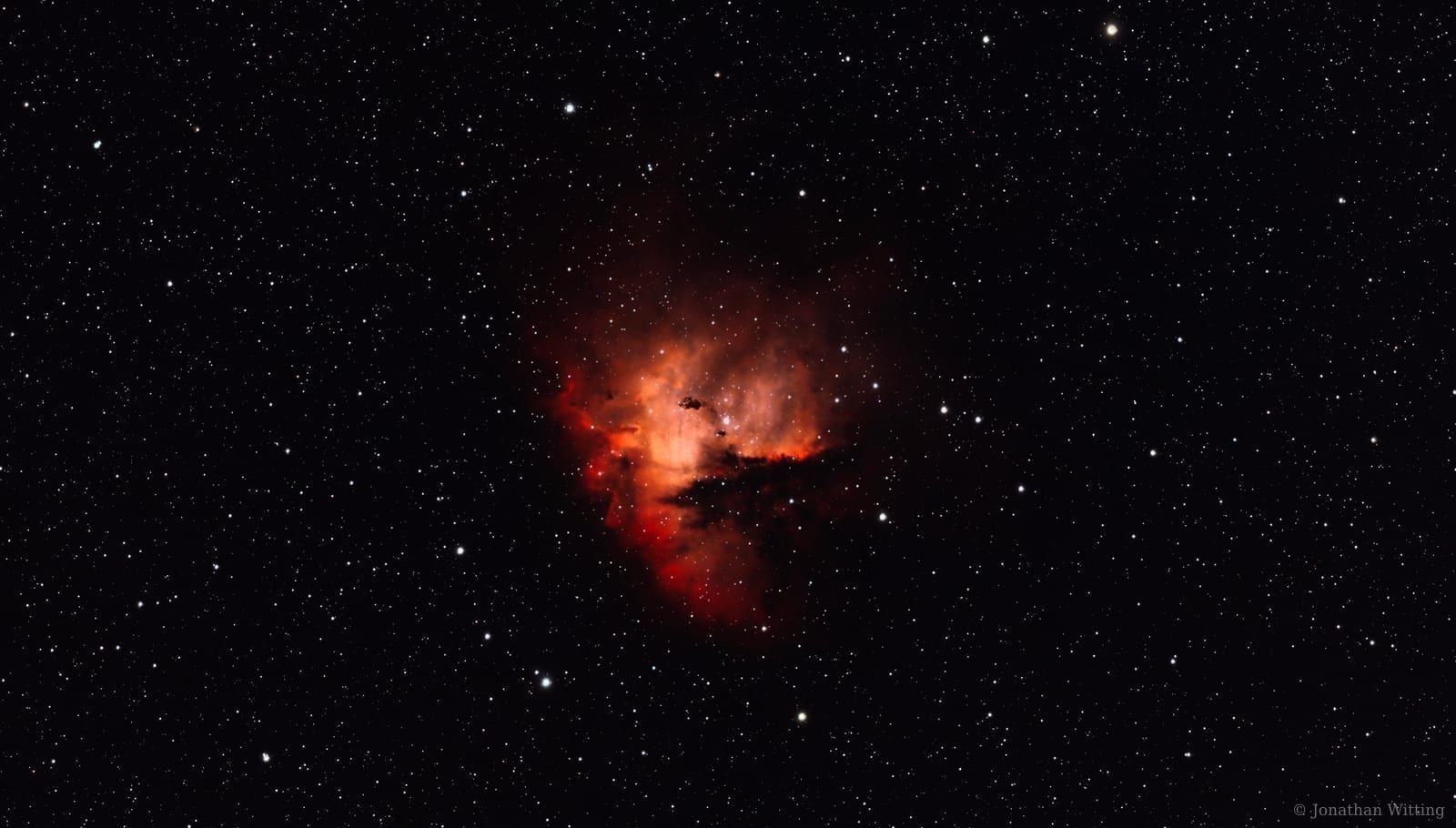
Point out NGC 281 to anyone who grew up in an arcade and they'll name it instantly. A dark lane of dust bites a wedge out of one side of this round emission nebula, and the resemblance to a certain pellet-munching video game character is so strong that the nickname has thoroughly displaced the catalogue number.
The glow itself is a cloud of hydrogen around 9,200 light years away in the Perseus Arm of our galaxy, lit from within by the young open cluster IC 1590. The dark lanes that give the Pacman its mouth are denser dust silhouetted against the glow, and dotted through the nebula are small, opaque knots called Bok globules, possible sites of the next round of star formation.
The essentials
| Designation | NGC 281 (cluster IC 1590) |
| Type | Emission nebula with open cluster |
| Constellation | Cassiopeia |
| Distance | ≈ 9,200 light years |
| Apparent size | ≈ 35′ × 30′ |
| Best season (UK) | September to December (circumpolar) |
Why it's a great target
For UK imagers the Pacman has a huge practical advantage: it's circumpolar from our latitude, so it never sets. It rides highest through the autumn, when Cassiopeia passes nearly overhead, which means you're shooting through the least possible atmosphere. It's a strong hydrogen-alpha emitter with useful OIII as well, so a dual-band filter pulls it cleanly out of suburban light pollution, and the mouth gives even a short integration an obvious, satisfying shape.
Capture notes
- Framing: at my 382mm focal length (f/5.9) the Pacman sits comfortably in the middle of the frame with generous sky around it. Centre it and rotate so the mouth reads clearly; there's no neighbouring showpiece competing for the composition.
- Filters: dual-band is the easy route with a colour camera. I used the Optolong L-eXtreme on the ASI 294MC Pro.
- Moon: Hα shrugs off moonlight well, so this is a sensible target to keep in reserve for brighter lunar phases, with the usual caveat that the OIII component fares better in darker skies.
My own dataset is proof you don't always need a marathon. I managed just 17 × 300s (under an hour and a half) before the weather closed in, then promptly forgot the data existed for months. When I finally stumbled back across it, the salvaged result really surprised me. That story is told in full in Rediscovering a Forgotten Nebula.
Processing notes
The contrast between the bright rim of the mouth and the dark lane is the whole image, so protect it: a heavy-handed stretch fills the mouth with glow and the character vanishes. Stretch gently, then use local contrast through a mask to deepen the dust against the nebulosity. With limited data, lean on careful noise reduction in the background while leaving the bright structure alone.