
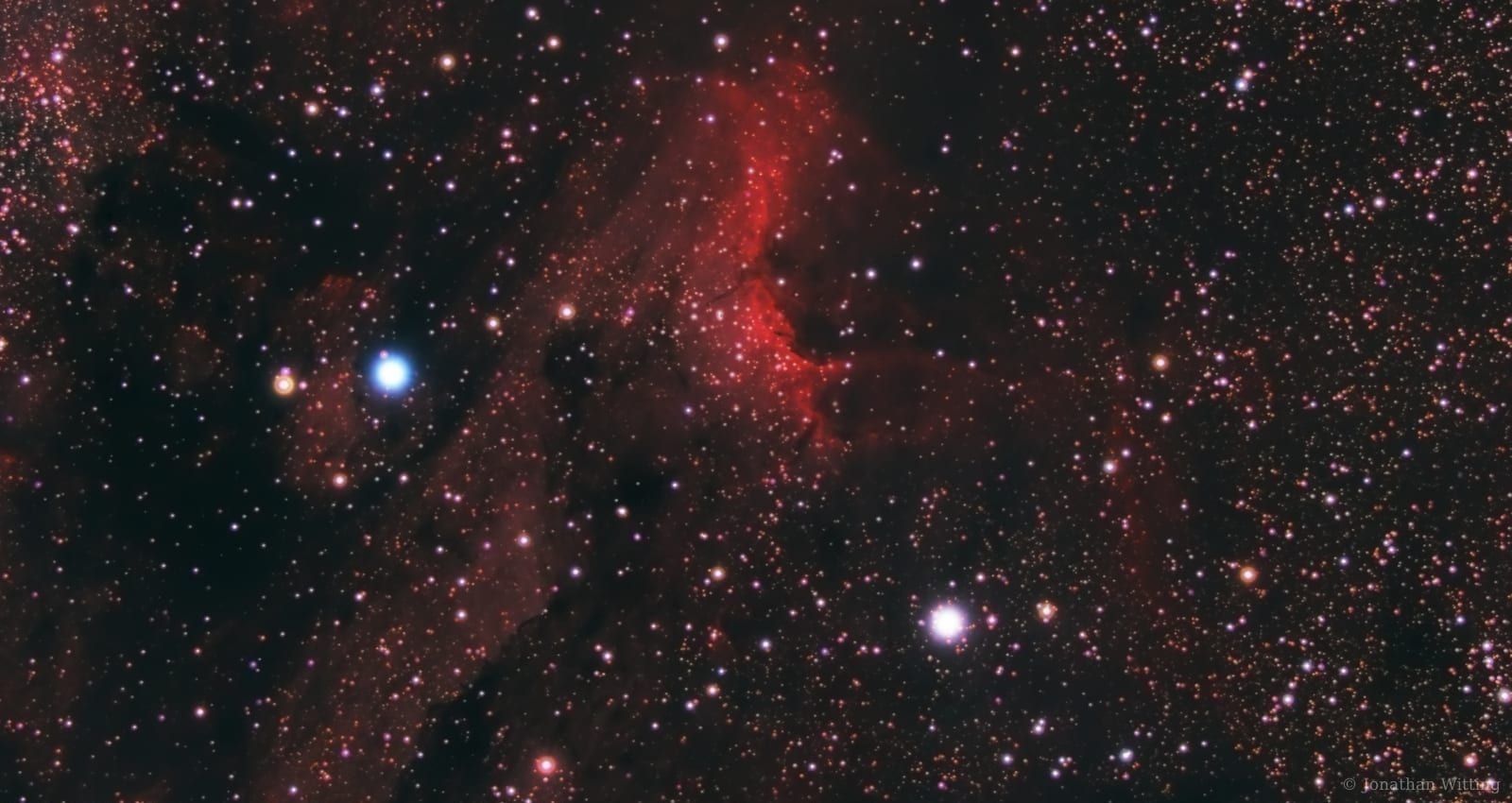
The Pelican Nebula sits in one of the busiest patches of the northern sky, a few degrees from Deneb in Cygnus. It's a region of glowing hydrogen around 1,800 light years away and roughly 30 light years across, and with a little imagination the long curve of its ionisation front becomes a pelican's head and beak.
It looks like a separate object from the neighbouring North America Nebula (NGC 7000), but it isn't. Both are part of the same enormous cloud of gas, and the apparent gap between them is a foreground lane of dark dust, catalogued as LDN 935, blocking the light from the nebula behind. The Pelican is the more active half in some ways: along its bright front, new stars are forming and firing off jets that slowly reshape the surrounding gas.
The essentials
| Designation | IC 5070 |
| Type | Emission nebula |
| Constellation | Cygnus |
| Distance | ≈ 1,800 light years |
| Apparent size | ≈ 60′ × 50′ |
| Best season (UK) | June to October |
Why it's a great target
From the UK the Pelican passes almost directly overhead on summer nights, which means you're shooting through the least possible atmosphere: better transparency, better contrast, fewer gradient headaches. It's bright in hydrogen-alpha, generous in size at short focal lengths, and full of structure: the rippled ionisation front, dark tendrils, and the deep shadow of LDN 935 along one side.
It also pairs naturally with its famous neighbour. If you image one, you'll want the other; I've covered NGC 7000 separately in the North America Nebula target guide.
Capture notes
- Framing: at about a degree across, the Pelican sits nicely in my 382mm field. Frame it with the dark lane and the "Gulf of Mexico" edge of NGC 7000 creeping in and the composition tells the whole story; the full pair needs a much wider field than the Zenithstar 81 gives.
- Exposures: I gathered 81 × 300 second subs (about 6.8 hours) over three nights, completely unfiltered on the ASI 294MC Pro, and the hydrogen signal still came through well. That said, from a light-polluted garden a dual-band filter would have boosted the contrast considerably, and it's how I'd shoot it today.
- Moon: unfiltered broadband captures want moonless nights. With a dual-band filter in place the Pelican will happily tolerate a fair amount of moonlight.
Processing notes
The interest is all along the ionisation front, so prioritise contrast there with a masked local contrast or sharpening pass once the data is stretched. This is a dense Milky Way star field, and star removal before stretching (adding them back gently at the end) makes the nebula much easier to read. Keep the dark lane properly dark too: overly enthusiastic shadow lifting turns LDN 935 grey and flattens the sense of depth.