
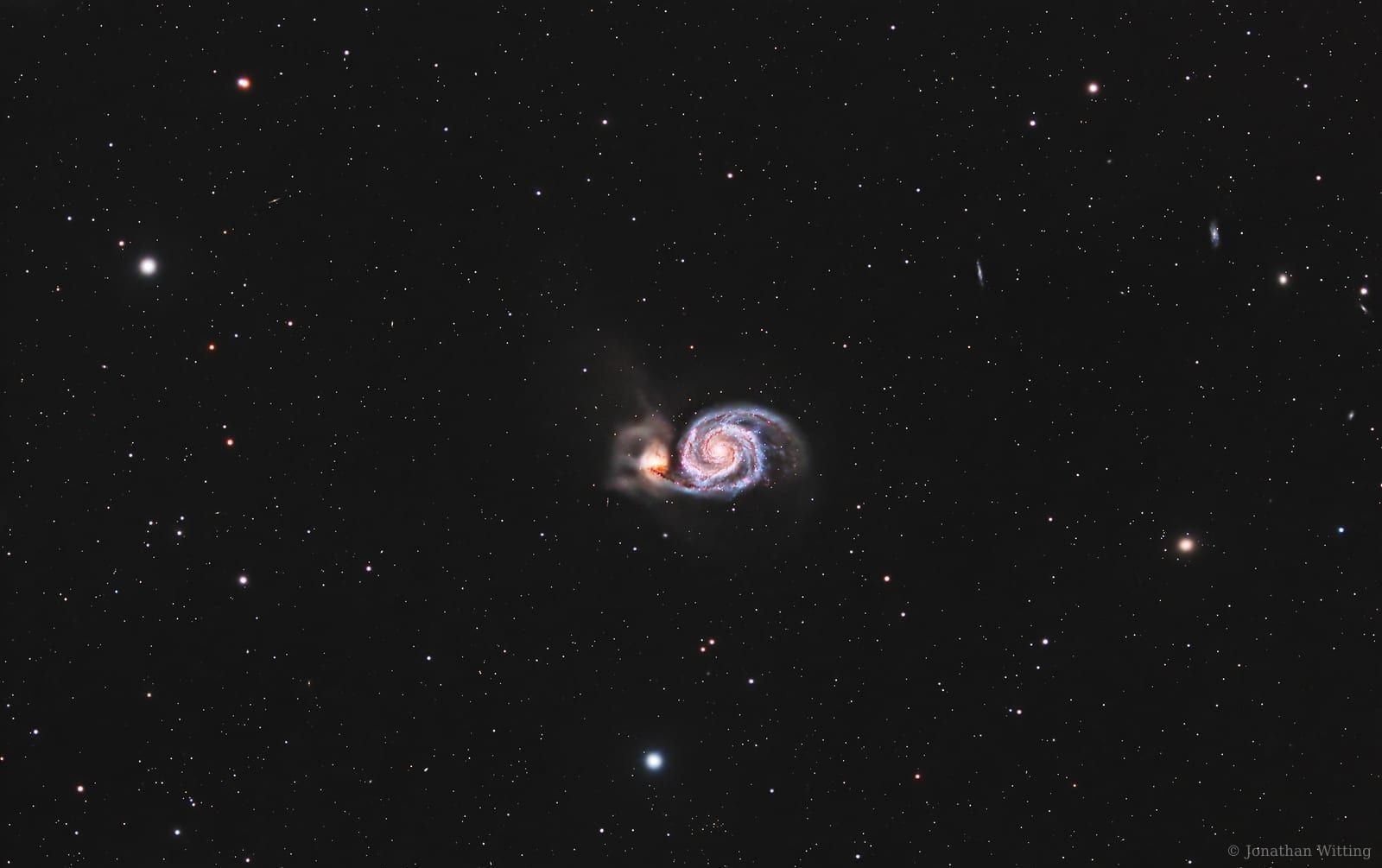
If you only ever image one galaxy, make it this one. M51 is the textbook grand-design spiral, two beautifully defined arms wound around a bright core, and it comes with a bonus: the dwarf galaxy NGC 5195, caught in the act of drifting past. The gravitational tug of that encounter is what sharpened M51's spiral structure so dramatically, and you can see the bridge of material connecting the pair in even modest integrations.
The two sit around 31 million light years away in Canes Venatici, just below the handle of the Plough, which makes M51 wonderfully easy to find and, from the UK, very well placed through spring.
The essentials
| Designation | M51 (NGC 5194), with companion NGC 5195 |
| Type | Interacting spiral galaxy |
| Constellation | Canes Venatici |
| Distance | ≈ 31 million light years (estimates vary) |
| Apparent size | ≈ 11′ × 7′ |
| Best season (UK) | February to June |
Why it's a great target
This is my favourite galaxy, and I keep coming back to it. It's bright as galaxies go, it shows obvious structure quickly, and the interaction with NGC 5195 gives the image a story rather than just a smudge. It also rides high from the UK in spring, so you're shooting through relatively little atmosphere.
It rewards a return visit as your kit improves. I first shot it in 2021 with an old Canon DSLR (70 × 180s) and was thrilled just to see the arms. In 2024 I came back with a mono camera and shot it in HaRGB (30 × 180s in each of Ha, R, G and B, six hours all in), and the hydrogen-alpha layer made the star-forming regions along the arms really pop. I covered that session in full in my Whirlpool in HaRGB write-up.
Capture notes
- Framing: at 11 arcminutes, M51 is small in my 382mm field, a stretch for the ZS81 if I'm honest, but workable. Centre it, accept the generous star field, and plan to crop. Image scale and seeing matter more than usual, so bin nothing and keep the guiding tight.
- Filters: plain LRGB or a one-shot-colour camera works well; this is a broadband object. If you shoot mono, an hour or two of Ha is well worth adding for the HII regions.
- Moon: broadband galaxy work wants dark skies. Save M51 for moonless nights and use the moonlit ones for narrowband targets.
Processing notes
A meaningful crop is part of the plan, so prioritise sharpness: careful deconvolution (or one of the modern sharpening tools) earns its keep here more than on any nebula. If you have Ha, blend it into the red channel gently; a little goes a long way before the arms turn lipstick red. Finally, don't clip the faint tidal bridge between the two galaxies when setting the black point. It's the best part of the image.